

Key Takeaways
- AI-powered forecasting in a contact center is limited by the data it can see, not by the model doing the forecasting
- Forecast accuracy depends on channel coverage, interval-level granularity, and visibility into what conversations actually contained
- Most contact centers hold voice, chat, messaging, and rep activity in separate systems, which produces separate and partial forecasts
- Unified data means every interaction, automated or human, lands in one structured record with the context around it
- VoiceSpin’s AI contact center software combines voice, digital channels, AI agents, and human rep management in a single platform
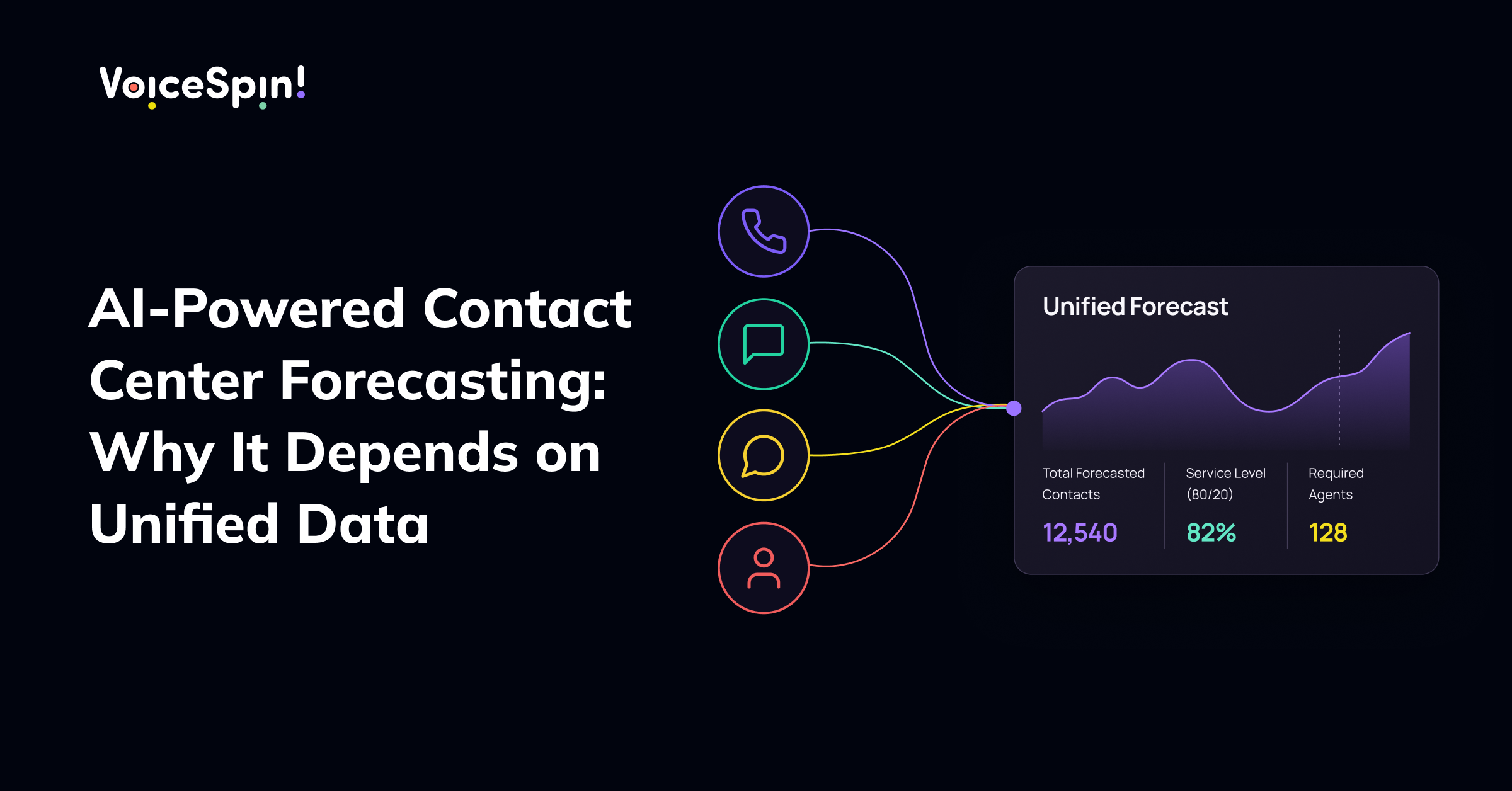
Most people talking about AI forecasting in contact centers tend to focus on the model. Which algorithm was used, how it was trained, how far ahead it can predict.
But the truth is, forecasting accuracy isn’t really about the model being the problem. It’s always the visibility of the operation that the model has that’s the issue.
What AI-Powered Forecasting Does in a Contact Center
Before getting to why data structure matters, it is worth being specific about what contact center forecasting covers, because the term spans several distinct jobs.
Contact volume forecasting predicts how many interactions will arrive, broken down by channel, hour, day, and queue. This is the foundation everything else sits on. Traditional approaches extrapolate from historical patterns and known seasonality. AI models add the ability to weigh many more variables at once, including marketing activity, product releases, billing cycles, and external events that historically moved volume.
Staffing and schedule forecasting turns predicted volume into a rep requirement. How many people, with which skills, in which intervals. Errors here are expensive in both directions. Understaffing produces abandonment and long queues, overstaffing produces idle time you paid for. Because service level is highly sensitive to small staffing gaps at peak intervals, accuracy at the interval level matters more than accuracy on the daily total.
Campaign outcome forecasting predicts how an outbound effort will perform. Expected contact rates, conversion rates, and how much rep capacity a campaign will consume. This is where AI forecasting differs most from traditional methods, because campaign outcomes depend heavily on what happens inside conversations rather than on volume alone.
Repeat contact forecasting predicts how much of next week’s volume will be generated by this week’s unresolved cases. This is one of the most useful things a model can surface and one of the hardest to do without complete data, since it requires linking a later contact to an earlier one that failed.
Seasonal and event forecasting handles the peaks that break normal patterns. Retail operations see this around holiday periods and campaign launches. The forecasting question is not only how high the peak goes but how its composition differs from a normal week, because peak traffic is often weighted toward different inquiry types than baseline traffic.
What Determines Contact Center Forecast Accuracy?
Three factors determine contact center forecast accuracy more than model choice does: channel coverage, interval-level granularity, and causal visibility into conversation content.
Coverage. A forecast built on the channels the model can see will miss demand moving through the channels it cannot. In operations where a growing share of contacts arrive through messaging, a voice-only forecast is describing a shrinking fraction of the business while appearing complete.
Granularity. Daily totals are close to useless for staffing. Service level is determined interval by interval, so a forecast that is accurate at the day level and wrong at the interval level will still produce missed targets and idle reps in the same shift.
Causal visibility. A model working from counts can extrapolate trends but cannot explain them, which means it keeps being surprised by shifts that were visible in conversation content well before they showed up in volume. A product issue generating calls appears in transcripts days before it appears as a spike.
That third factor is where most forecasting programs quietly underperform, and it is not a modeling problem. It is a data problem.
The Fragmentation Problem
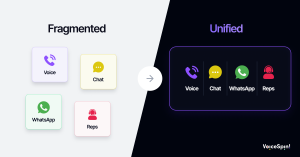
A typical contact center runs voice through one system, live chat through another, WhatsApp and messaging through a third, and rep scheduling and performance through a fourth. Each produces its own reports. Each reports accurately on what it can see.
The trouble is that none of them can see the whole picture, and a customer does not experience the operation in fragments. Someone starts on WhatsApp, does not get resolution, and calls in. In the data, that is two unrelated events in two unrelated systems. In reality it is one customer with one problem, and the second interaction exists because the first one did not finish the job.
Forecast from those systems separately, and you get plausible numbers that miss the relationship between them. Voice volume looks like it’s rising for no reason. Digital deflection looks successful because the chat system resolved the conversation, in the sense that the conversation ended. But nobody can see that it ended because the customer gave up and phoned.
What Is Unified Data in a Contact Center?
Unified data in a contact center is not a dashboard that pulls from several sources. It is a single operational record where every interaction lands in the same place with the same structure.
That includes several layers that are usually separated:
Every channel. Voice, AI chatbot conversations, WhatsApp, SMS, email, live chat, held as one stream rather than parallel ones.
Both automated and human handling. What the AI voice agent resolved, what it escalated, what the human rep did next, and how the case closed. Systems that automate one layer and report on it separately from the human layer produce two incomplete stories.
The structural context around the interaction. Which rep handled it, which campaign it belonged to, which queue it came through, what time it happened, what the customer’s history was. The metadata is often what turns a transcript into something a model can learn from.
The content of the conversation, not just its metrics. This is the part most operations lack entirely. Knowing that a call lasted six minutes and ended in a transfer tells you almost nothing about why.
Why Content Changes What AI Can Forecast
Traditional contact center forecasting works from counts. Volume by hour, average handle time, abandonment rate, service level. These are useful and they are also thin. They describe the shape of the operation without describing what happened inside it.
When the full conversation is available to a language model, the input changes category. Instead of forecasting from the fact that call volume rose last Tuesday, a model can work from what people were actually calling about, how those conversations went, where they broke down, and which of them ended with an unresolved customer likely to call again.
That produces forecasts that answer more useful questions. Not only how many contacts to expect, but what kind, driven by what, and which of them are repeat contacts generated by an earlier failure.
It also improves campaign forecasting specifically. When an entire outbound campaign’s conversations sit inside one structured dataset, patterns become visible that no summary metric would surface. Which objections actually stall deals rather than which reps report stalling. Which openings hold attention. What separates the conversations that convert from the ones that end politely.
The Insight Layer Managers Actually Need
Contact center managers are rarely short of reports. They are short of context.
A report will tell you that the first contact resolution dropped three points. But it doesn’t explain why. Was it because of a new product causing a bunch of unfamiliar questions, a change in policy that the reps weren’t told about, a routing rule that’s sending calls to the wrong people, or just some seasonal shift in the customer base? Usually, the only way to figure that out is to start listening to the calls and asking around.
An AI layer sitting on unified data can do that work at a scale no manager can match manually. It reads every interaction rather than a sample, and it can connect the drop in resolution to the specific topics driving it, the queues where it concentrates, and the point in conversations where things go wrong.
This is what separates business intelligence from reporting. Reporting tells you what the numbers were. Intelligence tells you what produced them.
Why End-to-End Matters More Than Any Single Feature
A contact center platform that automates voice but leaves digital channels elsewhere has solved a workflow problem and created a data problem. The same is true in reverse.
The value of an end-to-end platform is not that it saves you from buying several tools. It is that everything the operation does ends up in one structured place, which is the precondition for any AI layer to be useful.
VoiceSpin covers both sides of the operation. AI voice bots and chatbots handling automated conversations, and the tools human reps work in, call routing, quality management, performance management, all writing to the same record. Automation without rep management leaves half the operation invisible. Rep management without automation leaves the other half.
Native CRM integration closes the loop, so that customer history and interaction history are not two separate datasets that have to be reconciled after the fact.
What Should You Ask Before Trusting an AI Forecast?
What data can the model actually see? If it forecasts from voice metrics alone in an operation where half of contacts arrive through messaging, the forecast is describing a fraction of the business.
Does it include conversation content or only counts? Metrics tell you the shape. Content tells you the cause. Forecasts built on counts alone will keep being surprised by things the transcripts would have predicted.
Are automated and human interactions in the same dataset? If the AI layer reports separately from rep activity, nobody can see the handoff, and the handoff is where most operational problems live.
Is the structural context attached? A transcript without knowing the rep, campaign, queue, and customer history is far less useful than the same transcript with them.
What granularity does it forecast at? Daily accuracy is not enough for staffing decisions that are made and felt interval by interval.
The Underlying Point
The competitive question in contact center AI is drifting away from model quality. Strong models are increasingly available to everyone.
What is not evenly distributed is the data those models get to work with. An operation that has consolidated voice, digital channels, automation, and human rep activity into one structured record can ask questions that a fragmented operation cannot ask at all, regardless of how good its models are.
Better forecasting is one of those questions, and it is not the main one. The real point is that an AI layer is only going to be able to figure things out based on what you can see. Most contact centers have made a big chunk of theirs invisible, and they probably didn’t even mean to.
Frequently Asked Questions
What is AI-powered contact center forecasting?
It is the use of machine learning to predict contact volume, staffing needs, and campaign outcomes based on historical and live operational data. It covers volume forecasting, staffing requirements, campaign outcomes, repeat contacts, and seasonal peaks. Its accuracy depends heavily on how complete and how structured the underlying data is.
Why does unified data matter for contact center forecasting?
Customers are always moving between channels, and if you’re only looking at one channel, you’re never going to see the whole picture. If a customer rings in because your chat service was useless, that looks like a completely unrelated business if your systems aren’t talking to each other.
What makes a contact center forecast accurate?
There are a few things that are going to matter more than what kind of machine learning system you use: first, making sure you’re capturing all your data from every channel; second, getting into the detail of every single interaction, rather than just looking at the big picture on a daily basis; and finally, actually being able to see what people are saying to get to the bottom of any big changes that are happening in the data.
What is the difference between contact center reporting and business intelligence?
Reporting describes what happened, such as volume, handle time, and resolution rates. Business intelligence explains what produced those numbers, which requires access to the content of interactions rather than only their metrics.
Can AI forecast outbound campaign performance?
Yes, and it improves considerably when the full campaign conversations are available rather than only outcome counts. Conversation content reveals which objections stall deals and which approaches hold attention, which summary metrics cannot show.
What data should a contact center consolidate first?
Start with the interaction record itself, ensuring voice and digital conversations land in one place with their structural context attached, including rep, campaign, queue, and customer history. Channel consolidation without that context produces volume that is still hard to reason about.




 +18889082995
 +442036084160
 +97237237006
 Call on WhatsApp

