

Every contact center manager knows the season is coming. In Israel, the stretch from late summer through the Tishrei holidays brings a surge in orders, bookings, and service requests, followed closely by Black Friday and year-end campaigns. Retailers, healthcare providers, travel companies, and financial services teams all feel the pressure at roughly the same time.
The go-to plan of forecasting the call increase and hiring enough reps to cover it only scratches the surface of the problem – it addresses the most visible part, but misses the more subtle changes that make peak season so tough to manage. A staffing plan that only accounts for volume will leave gaps that customers will quickly notice.
This article will look at what happens beyond the sheer number of contacts during seasonal peaks – and what contact centers need to do to be ready.
The Reasons Customers Get in Touch Change
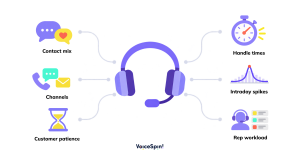
During a regular month, a contact center handles a fairly stable mix of inquiries. Peak season disrupts that mix. A retailer that normally fields product questions suddenly receives large numbers of delivery status requests, return inquiries, and questions about promotions. A healthcare provider may see a jump in appointment rescheduling before the holidays, while a travel company deals with changes, cancellations, and last-minute bookings.
This matters for staffing because each contact type requires different skills and takes a different amount of time. Forecasting total volume without breaking it down by contact reason can produce a schedule that looks correct on paper while placing the wrong reps in the wrong queues. Contact centers that review last season’s data by category, rather than as a single total, can build a far more accurate picture of which skills they will need and when.
Channel Preferences Move
Seasonal peaks also shift how customers choose to reach a business. When phone wait times grow, many customers turn to WhatsApp, web chat, or email instead, and in the Israeli market WhatsApp in particular tends to absorb a significant share of that overflow. If digital channels are staffed at their normal levels, the pressure simply moves from one queue to another rather than being resolved.
Planning for peak season therefore means forecasting each channel separately and deciding in advance which reps can move between voice and digital conversations as demand changes throughout the day. An omnichannel setup where reps see the full customer history across channels also helps prevent duplicate contacts, which tend to multiply when customers who are waiting try a second channel.
Customer Patience Runs Shorter
Customers getting in touch with a business as the holidays are approaching are often already running against the clock themselves. It’s just not great timing – an order delayed just as you were counting on it to be on the table for holiday dinner, a booking problem only days away from your trip – it’s going to create a much more serious, and often much more emotional, conversation than if this same problem comes up in a slow month.
This has a real impact on how you can meet your service level targets. For one, abandonment rates tend to spike during peak periods because people just aren’t prepared to wait around as long – a target that flew for you in March isn’t going to cut it in September. It also affects who should be out on the front lines to handle these calls – when a customer comes at you already pretty fired up, you want people who have the expertise, empathy and clout to sort out the issue right there on the first try and not have to bounce it off to someone else.
Handle Times Behave Differently
It is tempting to assume that average handle time stays constant and simply multiply it by the forecasted volume. In practice, handle times often move during peak season for several reasons at once. Seasonal reps who are still learning the systems need more time on each contact, experienced reps receive a larger share of complex escalations, and new promotions or temporary policies introduce questions that nobody has answered before.
A realistic staffing model accounts for these shifts by estimating handle time separately for new and tenured reps, and by adding a buffer for contact types that are likely to become more complex during the season. Without that adjustment, even a well-staffed team can fall behind within the first few days of a peak.
Intraday Patterns Become Harder to Predict
Outside of peak season, contact centers usually see pretty consistent daily patterns. But during a holiday period those patterns disappear. Marketing campaigns, delivery cutoffs, shortened business days before holidays, and even the weather can create sudden spikes that don’t follow historical trends.
This is where flexibility becomes just as important as headcount. Contact centers that can adjust schedules at short notice, open overflow routing and get real-time queue data are in a much stronger position than those relying on a fixed schedule created weeks in advance. With real-time monitoring, supervisors can spot a developing issue – such as a sudden cluster of calls about a single delayed shipment – and respond before it overwhelms the queue.
Knowledge Requirements Grow
Every seasonal campaign brings its own set of rules. Promotional terms, extended return windows, holiday operating hours, and temporary shipping policies all need to be understood by every rep who might face a question about them. When that information is spread across emails and separate documents, consistency suffers and handle times rise.
Preparing a single, updated knowledge source before the season starts, and making sure both reps and AI agents draw from it, reduces errors and ensures customers receive the same answer regardless of which channel they use or who they speak with.
Experienced Reps Carry More of the Load
One of the less visible effects of peak season is the pressure it places on tenured reps. They are often asked to handle the most difficult conversations, support new colleagues, and cover extra hours at the same time. Over several weeks, that combination increases the risk of burnout at exactly the moment the contact center depends on them most.
Protecting experienced reps is an essential part of seasonal planning. That can mean scheduling dedicated coaching time rather than expecting ad hoc support, rotating reps between high-intensity and lower-intensity queues, and making sure that straightforward, high-volume inquiries do not take time away from the people best equipped for complex cases.
Where AI Agents Fit Into Seasonal Planning
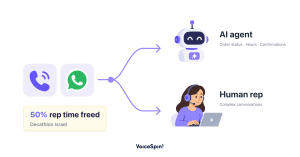
AI agents have become a practical tool for managing seasonal demand, adding capacity where it is needed most while reps remain at the center of the customer experience. Inquiries such as order status, appointment confirmations, operating hours, and simple account updates can be handled by AI agents around the clock, across both voice and messaging channels, without waiting in the same queue as more complex requests.
As a result, reps can focus on the conversations that benefit from human judgment, while customers with simple questions receive immediate answers. Decathlon Israel offers a clear example. After implementing the VoiceSpin AI call center together with a WhatsApp AI chatbot integrated with Zoho CRM, the company freed up 50 percent of its reps’ time while serving around 700 customers a day, giving the team significantly more capacity to manage demanding periods.
AI agents also scale instantly, which makes them particularly valuable during the unpredictable intraday spikes described above. When volume jumps unexpectedly, they absorb the additional straightforward contacts while reps continue working through the queue with the attention each customer deserves.
Building a Seasonal Staffing Plan That Goes Beyond Volume
You can’t put together a decent seasonal plan by just looking at some magic number – not when you’re considering all the different reasons people are getting in touch, and which channels they’re using. You need to start by forecasting based on all that – using last year’s or the year before as a baseline. And you’ve got to get realistic about how much time it’s going to take your new and more experienced reps to handle each call. That means adjusting your targets for how quickly you’ve got to answer, to reflect the fact that customers just aren’t as patient as they used to be.
Get your seasonal reps on board early enough that they’ve had plenty of time to get their training done, before the phones start ringing off the hook. That means sorting out a single up-to-date knowledge base well in advance, and not just pushing it out the door when you most need it. And meanwhile you’re going to want to be keeping a close eye on performance in real time, so you can make adjustments on the fly – like bringing in some flexible scheduling and letting AI agents handle all the easy questions, so your human reps can focus on the ones that really matter.
And when it’s all over, take the time to sit down and figure out what actually worked, which types of calls – or whatever – grew the most, and where things got a little hairy. That’ll give you a much better idea of what to expect next time round, and how you can make your plan even more solid.
Conclusion
Seasonal peaks certainly put your contact center through its paces. Not just its ability to answer a few extra calls. I mean the whole mix of calls, the way customers want to be contacted, what they expect – the lot. And if your plan is just based on ‘how many more calls are we going to get’ it’s a non-starter. All these things shift all at once, and you’ll find yourself struggling to keep up.
But contact centers that take the time to think ahead – using some smart scheduling for your reps, and bringing in an AI agent to add some extra capacity when you need it – can deliver a consistently good service when people really need you to. VoiceSpin helps businesses out here in Israel sort this out, with AI-powered voice and messaging solutions that can scale with demand.
Frequently Asked Questions
How far in advance should a contact center plan for seasonal peaks?
Most contact centers benefit from starting their seasonal planning two to three months before the expected peak. This allows enough time to analyze data from previous seasons, recruit and train seasonal reps, update the knowledge base, and configure any AI agents or routing changes before volume begins to rise.
How do you forecast call volume for peak season?
The most reliable forecasts use historical data from the same period in previous years, broken down by contact reason, channel, and time of day. These figures should then be adjusted for known factors such as planned marketing campaigns, new products, policy changes, and the timing of holidays, which shift from year to year in the Hebrew calendar.
How can seasonal reps be trained quickly without affecting service quality?
The way to get seasonal reps up to speed quickly is to make sure they’re getting training that’s focused on the kinds of calls they’ll be dealing with, and that’s backed up by a clear and up-to-date knowledge base. Getting them paired up with more experienced colleagues, either through scheduled coaching sessions or just by working alongside them, helps them build confidence while also making sure they don’t have too much on their plates. And routing the harder, more complicated calls to experienced staff during their first few weeks can really help them out.
Can AI agents help contact centers manage seasonal call volume?
AI agents can handle the straightforward, high-volume stuff like checking on orders, confirming appointments, or telling people what the hours are – and they can scale right up in an instant when demand goes through the roof. This means you’ve got a bit of breathing space to deal with the calls that actually need some human empathy and problem solving.
What metrics should a contact center track during peak season?
The key ones are service level, abandonment rate, average handle time, first contact resolution, and sticking to the schedule – ideally tracked in real time and by channel. And it’s just as important to keep an eye on your staff’s workload and overtime – because sustained pressure on the experienced staff can really start to take its toll late on in the season.



 +18889082995
 +442036084160
 +97237237006
 Call on WhatsApp

