

Almost every call center is under significant pressure to reduce average handle time, and most of them go about it the same way, by telling their reps to rush through calls. That strategy produces a number that looks good on the dashboard while service quality quietly declines.
The trade-off that comes from this approach is something that is very measurable. Industry research on contact centers that really pushed hard on reducing handle time found those that did to cut average AHT by 18% over the course of a year while simultaneously losing 11 points of customer satisfaction over the same time period. As for the reps under this pressure – they responded by skipping discovery questions, ending calls as quickly as possible, clearing the queue instead of actually solving the problem & the calls would come back a week later as repeat contacts – essentially meaning the total work never actually went down.
This article is about how to really reduce average handle time in a call center – by cutting out the bits of a call that have nothing to do with listening to the customer.
What Average Handle Time Actually Measures
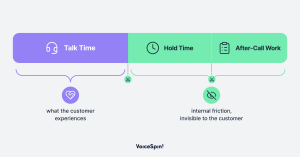
Average handle time measures up the time a rep spends on one call from start to finish, divided by all the calls they’ve handled. For voice calls that breaks into three components:
AHT = (talk time + hold time + after-call work) ÷ number of calls handled
The third component is the one most teams underweight. After-call work covers the notes, disposition coding, CRM updates, and follow-up tasks a rep completes once the customer has hung up. The customer is not present for any of it, yet it counts fully toward your handle time.
This matters because it tells you what to aim for. Talk time is the customer’s experience of the call. Hold time and after-call work are your internal friction. A reduction program that targets the wrong bits is a waste of time.
Recommended reading: Top 10 Outbound Call Center Metrics Your Call Center Should Measure
Average Handle Time Benchmarks for 2026
Before setting a target, it helps to know where the industry actually sits. The figures below are reference points rather than goals.
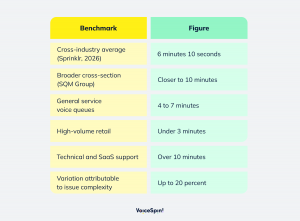
These figures are more of a reference point than a goal.
Retail and support call centers are at opposite ends of the scale. A blended average across all sectors doesn’t tell you much and benchmarking against the wrong figure is just going to lead to wrong conclusions all down the line.
Set ranges by call type instead, and track the trend within each rather than the blended figure across all of them.
Why Cutting AHT Directly Backfires
When AHT becomes a target that reps are measured against individually, several things happen in sequence.
Reps start rushing the beginning of calls and glossing over the diagnostic questions. Not as many questions get asked, so the diagnosis isn’t as good, which means you end up with lots of issues that seem fixed but really aren’t.
Those incomplete resolutions return as repeat contacts. The second call does not appear in last month’s AHT figure, so the dashboard shows an improvement that the total workload does not reflect. Cost per resolved issue, which is the number that actually matters, moves in the wrong direction while cost per call improves.
If your AHT is going up, that’s usually a sign something’s changed in your call volume, or your tools, or how reps are trained. It is a signal worth investigating, not a number to squeeze.
Where the Time Actually Goes
Before changing anything, break your handle time into its three components and look at which one is driving the total. The right fix is completely different depending on the answer.
If talk time is rising while hold and wrap stay flat, your call mix has gotten more complex, or your reps lack the information to move a conversation forward efficiently. The fix is knowledge access and call structure, not speed coaching.
If hold time is rising, the problem is almost always routing or information architecture. Reps are placing customers on hold because they need to find something or consult someone. Neither is solved by asking them to hold less.
If after-call work is climbing, the cause is your systems rather than your people. Too many screens, too much manual entry, disposition menus with forty options. The fix is automation and interface design, and coaching reps to type faster achieves nothing.
This diagnosis step is what separates a program that works from one that produces a temporary dip followed by a rebound. High handle time is rarely caused by reps talking too much. It is usually the result of structural friction that slows the conversation down before the rep ever picks up.
Seven Ways to Reduce AHT Without Rushing Reps
Each of these targets time that your customers don’t even notice as part of the conversation.
1. Automate after-call work
This is the highest-return change available to most call centers, because it cuts handle time with no effect at all on call quality. Structured wrap-up forms replace free-text notes, AI-generated call summaries replace manual note-taking, and automatic CRM field population replaces duplicate entry across systems.
Teams who make this change often save around 20-40 seconds on each call – that’s around 5-11 hours a day off the clock for a queue that handles a thousand calls a day.
2. Fix routing so reps handle calls they are equipped for
A rep who receives a call outside their competence either takes longer to resolve it or transfers it, and both outcomes inflate handle time. Skills-based routing sends each call to the rep best equipped to resolve it on the first attempt.
3. Put context on the screen before the rep speaks
A screen pop that comes in with the call, giving them the customer’s background, previous interactions and outstanding issues, saves them having to ask routine opening questions. “Who’s calling and what did they call about?” – that’s a quick glance at the screen instead.
This is where CRM integration earns its keep operationally rather than administratively. Context that arrives with the call is context nobody has to assemble during it.
4. Eliminate hold time with better knowledge access
Hold time is usually a search problem. A rep places a caller on hold because the answer is somewhere in a system they cannot query quickly. A searchable, current knowledge base that reps can consult without leaving the call turns a ninety-second hold into a five-second pause.
Where hold is genuinely unavoidable, queue callback converts waiting time into a scheduled return call, which improves the customer’s experience even where it does not reduce the handle time itself.
5. Reduce transfers
A call gets passed around and the second person often has to start all over because the customer has to tell the whole story again. Tracking transfer rates alongside AHT is worth doing, since a high transfer rate inflates handle time across both queues while damaging customer satisfaction.
Where transfers are necessary, passing full context with the call is what prevents the customer from starting over.
6. Deflect routine calls entirely
The most effective way to reduce handle time on a routine call is to prevent it from reaching a rep at all. An AI voice bot can resolve balance inquiries, appointment confirmations, order status checks, and similar structured requests end-to-end without a person involved.
Self-service containment can be anywhere from 20-60% depending on how far along you are with automation and what kind of calls you’re getting.
7. Give reps real-time assistance
If a rep is pausing to search for an answer, a system that surfaces the right answer in the middle of the conversation can save the call without hurting quality. You keep the diagnostic depth of the call, but lose the dead time.
Recommended reading: Call Center Agent Onboarding in the Age of AI
The Automation Paradox: Why Good Automation Raises Your AHT
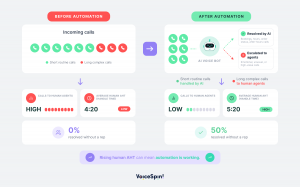
When automation resolves routine calls successfully, those short calls no longer count toward your average handle time.
What’s left in the queue are all the complicated, emotional, multi-step calls that always took longer than average. That’s what’s now dragging up your human AHT – and it can jump noticeably, right when your automation is succeeding.
That is a healthy signal rather than a regression, and it needs to be explained to whoever reads the dashboard before it happens rather than after.
Looking at your 2026 metric isn’t just about how many seconds you’re talking about on its own. It’s what percentage of calls are getting wrapped up without a rep needing to pick up the phone, and how long those calls that do get handed off to a rep are taking. A call center that automates half its volume but ends up with human AHT going up by a minute has still made a big leap forward – even if the headline number looks bad.
Guardrail Metrics to Track Alongside AHT
Never report handle time on its own. These four numbers tell you whether a reduction is real or borrowed from somewhere else.
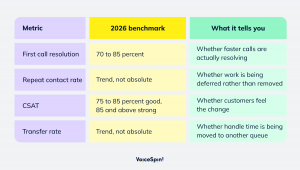
The rule is straightforward. If AHT falls while first call resolution holds and CSAT holds, the improvement is genuine. If AHT falls while repeat contacts or transfers rise, you have not reduced work at all. You have relocated it, and it will cost more the second time.
A Real Example: 47 Percent AHT Reduction
VoiceSpin’s work with Israel’s Ministry of Transport on the Safe Return project illustrates what the automation route looks like when it is applied to a high-volume public service line.
The deployment automated the routine, repetitive inquiries that made up a large share of inbound volume, with more than half of all contacts resolved without a human rep. Average handle time on the remaining work fell by 47 percent, and availability reached full coverage rather than the business hours a staffed line could sustain.
The mechanism is the one described above. Routine calls get bumped out of the human queue, and what’s left gets automated help with handling data & context, leaving reps free to deal with the calls that actually require an expert decision.
How VoiceSpin Can Help
Cutting average handle time for real requires tackling the parts of a call that customers don’t even think of as conversation – it’s a technical issue, rather than something that needs to be worked on with reps.
VoiceSpin’s AI Voice Bot resolves routine inbound calls end-to-end, removing them from the human queue entirely. AI Call Summary generates structured wrap-up automatically at the end of every call, which is where the fastest measurable gains usually appear. Skills-based routing and ACD place each call with the rep most likely to resolve it first time. Integration with eleven CRM platforms means the customer record is on screen before the rep says hello.
Our AI Speech Analyzer then evaluates 100 percent of calls rather than a manual sample, which is what allows you to verify that a falling handle time is coming from removed friction rather than from rushed conversations. Without that verification, an AHT program is running blind on the one question that matters most.
Book a demo to see how these apply to your own call mix.
Frequently Asked Questions
What is a good average handle time for a call center?
Typically, the 2026 cross-industry benchmark is around 6 minutes and 10 seconds, but it can vary a lot – some places are up to 10 minutes, others are as low as 3. Issue complexity alone can add up to 20% difference, so it’s pointless trying to set one target for everything. Set ranges based on call type and track the trend within each.
How do you calculate average handle time?
You add up the total talk time, hold time and after-call work, then divide by the number of calls you’re dealing with in that period. That after-call work bit is the one teams most often forget, which gives you an AHT figure that’s way too low.
Does reducing AHT hurt customer satisfaction?
No, if you’re not rushing through conversations to get the numbers down. But if you are pushing down on AHT, you often end up with lower CSAT and first call resolution as well, because the customer has to phone back later.
What is the difference between AHT and average talk time?
Talk time is just the bit where the rep and customer are on the phone talking, AHT is the lot – talk time, hold time and after-call work. So it’s always the bigger figure. If you report just talk time in place of AHT, you’re understating your true cost per call.
Why did our AHT go up after we deployed automation?
Automation removes the easy calls first, leaving the harder ones that take longer, which makes your AHT go up. But if you track the share of calls that get resolved without a rep along with your AHT, you should get a proper picture.
How quickly can a call center reduce average handle time?
If you sort out the after-call work and get your reps some screen pops to work with, you should see the numbers start to change within a few weeks. Routing improvements are a bit trickier, as you need to get your skills mapping right before you start to see improvements.



 +18889082995
 +442036084160
 +97237237006
 Call on WhatsApp

