

The terms ‘call center’ and ‘contact center’ are bandied about so liberally in job postings, vendor sales pitches and industry chit-chat – but they’re really talking about two very different beasts, each with their own operational model, tech stack, agent requirements, customer experience and business outcomes.
Getting your head around the distinction between call center and contact center isn’t just a matter of nomenclature. It’s a choice that can have a direct impact on how your customers experience your brand, the tech you need to invest in, how you train and manage your agents, and – most importantly – whether you can genuinely compete in a market where customer expectations are higher than ever.
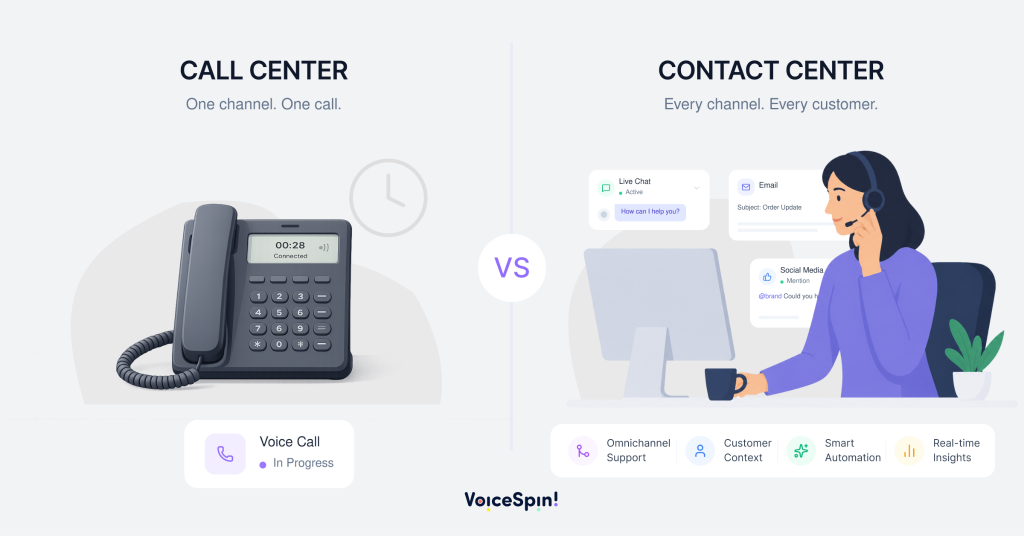
This guide breaks down the contact center vs call center difference in real-world terms – including what each model looks like, how they compare across six key areas, which one is best for your business and what the software landscape looks like for each.
What is a Call Center?
A call center is a centralised hub where agents handle customer communications just by phone – no emails, chats or social media interactions allowed. Some call centers are just for receiving customer calls – whether it’s support, a question or a complaint – while others are for making calls – for sales, collections, surveys or setting appointments. And then there are the ones that handle a bit of both – a bit of both inbound and outbound call volume.
Gartner says that a call center is “a group of staff that deal with huge volumes of phone calls”. And that’s the bottom line – it’s all about phone calls.
Call centers are all about handling phone calls. Their tech is built around phone technology, automated call distribution, interactive voice response, call recording and metrics that focus on call volume, how long each call lasts, and how many issues get sorted out straight away.
And guess what? In 2026, call centers are still going strong – still serving businesses that rely on phone calls to get the job done – like transactional operations, high volume, voice-only setups.
What is a Contact Center?
A contact center is a central hub where agents deal with customer communications across loads of different channels – phone, email, live chat, SMS, WhatsApp, social media, video and whatever else is out there. The reality is that customers no longer just use the phone to get in touch. That’s why contact centers have emerged as a way for customers to reach companies on the channel of their choice.
The main difference between a contact center and a call center is the channels they cover. A contact center handles phone calls as just one of the options, with agents managing interactions across every single channel from a single platform.
To make a contact center work, you need a broader tech stack that includes routing across loads of channels, CRM integration, AI-powered automation, analytics that cover all channels and the smarts to keep up with customers as they switch between channels.
Gartner reckons that by 2026 one in every three customer service interactions will be handled entirely by conversational AI – a prospect that’s impossible without a contact center architecture.
Contact Center vs Call Center: 6 Key Differences
1. Communication Channels
The most fundamental difference between contact center and call center is the range of channels each handles.
A call center handles voice calls only – inbound, outbound, or both.
A contact center handles voice AND any combination of email, live chat, SMS, WhatsApp, social media, video and messaging apps – often all at once, all through the same agent interface. This matters because customer preferences have shifted massively. Customers now expect to reach companies on their preferred channel and get consistent service when they switch between channels. Businesses that only use a call center are invisible on the channels where a growing section of their customers want to engage.
2. Technology Stack
Call center technology is built around telephony. The core components are a phone system or VoIP platform, ACD for routing inbound calls, IVR for self-service navigation, call recording, and reporting tools focused on call metrics.
Contact center tech is more complex. In addition to all the phone components, a contact center needs omnichannel routing that distributes interactions across channels in a clever way, CRM integration that keeps a single customer record across all channels, AI-powered chatbots and voice bots to automate resolution, messaging platform integrations, analytics that cover all channels and workforce management tools that handle scheduling and performance management for agents across multiple channels.
The gap between call center vs contact center software reflects this difference. Call center software is optimized for voice. Contact center software is built around a unified intelligence layer that connects every channel, every interaction, and every piece of customer data into a single platform.
3. Agent Skills and Roles
In a call center, agents are specialists in voice communication. Their skills are all about telephone etiquette, active listening, speaking clearly under pressure and navigating phone-based workflows.
In a contact center, agents have to be effective communicators across voice and written channels. They handle live conversations by phone while juggling chat threads or email queues – requiring strong written communication skills, the ability to handle multiple interactions at once and proficiency with a more complex tech environment.
This difference has massive implications for hiring, training and workforce management – contact center agents need broader skill sets and that means a more expensive training investment.
4. Customer View and Data
A call center only captures data from voice interactions. Customer records reflect phone-based history – call logs, recordings and notes from phone calls.
A contact center creates a single customer record that spans every single channel. When a customer emails support, then follows up with chat, then calls in, a contact center platform gives the agent a complete picture of the entire interaction history – no matter which channel each exchange happened on.
This customer view is one of the biggest advantages of the contact center model. It means the customer doesn’t have to suffer through the frustration of having to repeat information they’ve already given to someone else – and gets a much more personalized service because the agent has a complete picture of their history.
VoiceSpin’s CRM integrations with Salesforce, HubSpot, Zoho, Pipedrive, and other leading platforms enable contact centers to maintain this unified customer view across every interaction – automatically syncing data from every channel in real time.
5. Metrics and Performance Measurement
Call center performance is still mainly measured by voice-related metrics: average handle time (AHT), first call resolution (FCR), call abandonment rate, calls per hour, and service level (the percentage of calls answered within a time limit). That’s because it’s been the only way to do things for years.
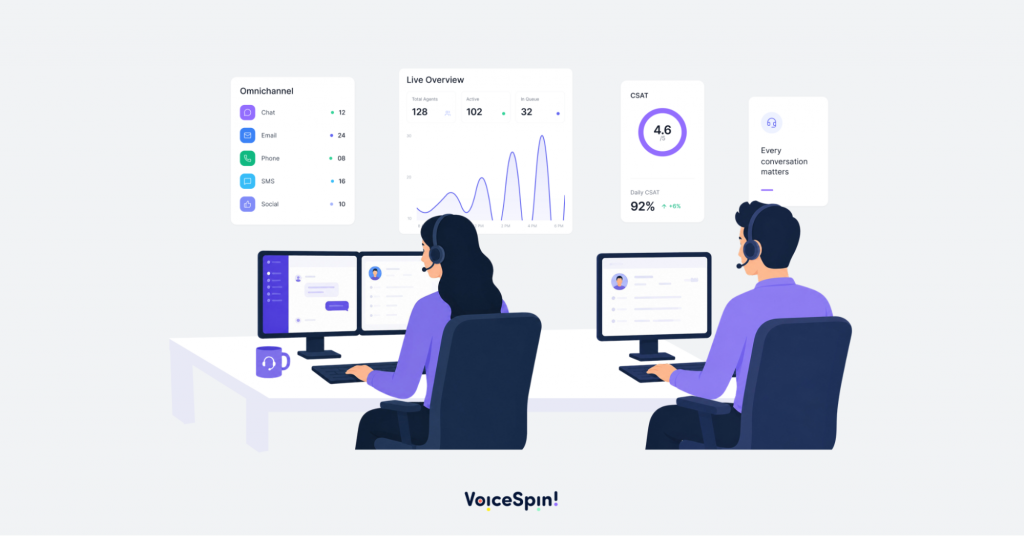
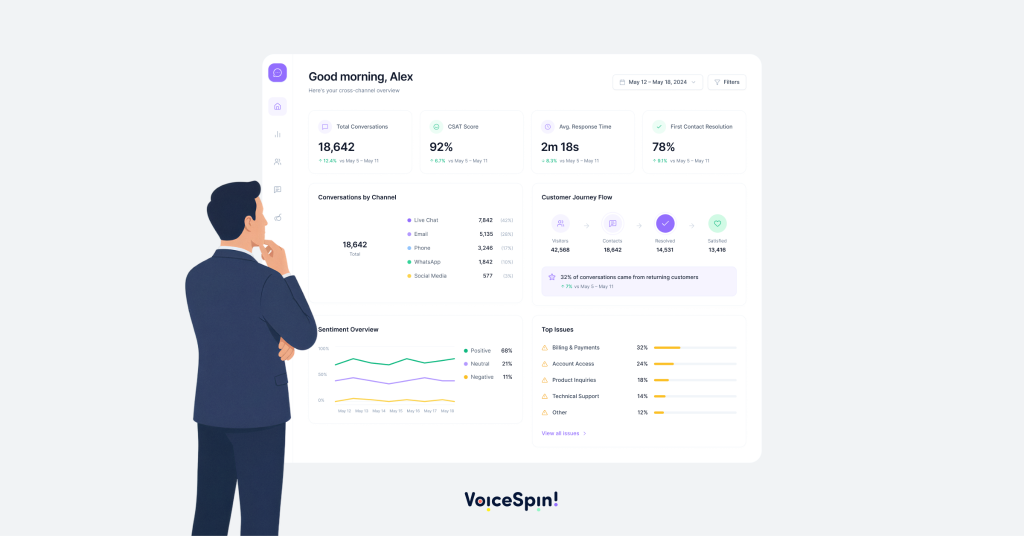
However, contact center performance measurement is a lot more complex – it involves multiple channels. So, in addition to voice metrics, center managers track first contact resolution across all the different channels, customer satisfaction score (CSAT), net promoter score (NPS), average response time by channel, digital deflection rates, and even how customers navigate across channels.
This gives them a much richer data set, which is one of the key benefits of the contact center model. The sheer volume and variety of data from all the different channels lets them do all sorts of more sophisticated analysis, targeted coaching and churn prediction than the voice data alone could give them.
6. AI and Automation Capabilities
In a call center, automation is largely limited to IVR – the “press 1 for sales, press 2 for support” menu systems that route callers through predefined decision trees. Basic IVR is rigid, frustrating for customers, and unable to handle anything outside its programmed scenarios.
In a contact center, AI transforms the entire operation. AI voice bots handle inbound calls with natural conversation capabilities, understanding free speech and resolving inquiries without human involvement. AI chatbots handle digital channel interactions simultaneously. AI speech analytics monitors 100% of interactions for quality, compliance, and sentiment. Predictive routing assigns each interaction to the agent with the highest probability of first-contact resolution.
The difference between a tone IVR and a modern AI voice agent is the same as the difference between an answering machine and a qualified employee. This AI capability gap is one of the most compelling reasons why businesses are transitioning from call center to contact center models in 2026.
Call Center vs Contact Center: Side-by-Side Comparison
| Call Center | Contact Center | ||
| Channels | Voice only | Voice, email, chat, SMS, WhatsApp, social, video | |
| Technology | Telephony, ACD, IVR, call recording | Omnichannel platform, CRM integration, AI automation | |
| Agent skills | Voice specialist | Multi-channel communicator | |
| Customer view | Phone interaction history | Unified cross-channel record | |
| Automation | Basic IVR | AI voice bots, chatbots, predictive routing | |
| Analytics | Call metrics | Cross-channel customer journey analytics | |
| Best for | Voice-first, transactional operations | Omnichannel customer experience |
What is Call Center vs Contact Center Software?
Call center software is designed to manage high-volume phone interactions. Key features include VoIP telephony, automatic call distribution, IVR, call recording, predictive and power dialers for outbound, real-time call monitoring, and reporting dashboards focused on voice metrics.
Contact center software encompasses all of the above plus omnichannel messaging, AI chatbot integration, cross-channel routing, social media management, unified customer timeline, workforce management, and AI-powered analytics across every interaction type.
The distinction matters when evaluating vendors. A platform marketed as “call center software” may handle voice exceptionally well but lack the digital channel capabilities, CRM depth, and AI automation that a true contact center operation requires.
VoiceSpin’s AI contact center software combines AI voice bots, AI chatbots, omnichannel messaging, predictive dialers, AI speech analytics, and deep CRM integrations in a single platform – designed for businesses that need both voice excellence and full digital channel coverage.
Which is Right for Your Business: Call Center or Contact Center?
Choose a call center model if:
- Your customers exclusively or predominantly contact you by phone
- Your interaction volume is manageable with a voice-only team
- Your use case is highly transactional with standardized responses
- You need outbound calling capabilities without digital channel complexity
- Your budget and technical infrastructure favor a simpler implementation
Choose a contact center model if:
- Your customers engage across multiple channels and expect consistency between them
- You want to reduce inbound call volume by deflecting routine inquiries to digital channels
- You need AI automation to handle interactions at scale without proportional headcount growth
- Your business operates across multiple markets or time zones where 24/7 coverage is required
- Customer experience is a competitive differentiator in your industry
- You need richer analytics and customer data than voice interactions alone can provide
For most businesses in 2026, the trajectory is clear. Customer expectations around channel choice, response speed, and personalization are being set by digital-first experiences – and meeting those expectations requires a contact center architecture, not a voice-only model.
How VoiceSpin Bridges Call Center and Contact Center Capabilities
VoiceSpin is built for businesses that need the best of both models – voice excellence and full digital channel coverage – in a single, AI-powered platform.
For voice: VoiceSpin’s AI Dialer and predictive dialer maximize outbound call efficiency by connecting agents only to live conversations. Inbound call center software with advanced IVR, call routing, and queue management handles high-volume inbound with minimal wait times.
For digital channels: VoiceSpin’s AI Messaging integrates WhatsApp, email, live chat, and social media into a single agent interface. AI chatbots handle digital channel inquiries autonomously around the clock.
For AI automation: VoiceSpin’s AI Voice Bot handles inbound calls with natural conversation capabilities, resolving inquiries without human involvement. AI Speech Analytics monitors 100% of interactions across every channel for quality, compliance, and sentiment.
For CRM integration: Native integrations with Salesforce, HubSpot, Zoho, Pipedrive, and 80+ other platforms maintain a unified customer record across every interaction.
Frequently Asked Questions
What is the difference between a call center and a contact center?
The real difference between a call center and a contact center is how many different ways customers are able to get in touch – or get in touch with you. A call center is only about the phone, taking or making calls. That’s pretty much it. A contact center on the other hand is about a lot more than just voice, its about email, live chat, text messages, social media, video and just about every other way you can think of that a customer might want to interact with you.
What is a contact center vs call center in terms of software?
When we talk about call center software we’re usually talking about something that can manage just voice calls – with features like telephony and call recording. Contact center software is a lot more like a Swiss army knife – it’s got everything that call center software has plus a whole lot more like the ability to handle messaging on different channels, the integration of Artificial intelligence to help answer questions and cross channel routing so that customers get the right answer from the right person no matter which channel they’re using.
Is a contact center better than a call center?
The truth is that for most businesses in 2026 a contact center is the way to go because it lets customers get in touch in a way they want to, keeps track of what’s going on with them across all sorts of different channels and enables you to use AI to make things easier for the customer.
What is the difference between contact center and call center agents?
A call center agent is someone who is really good at handling just phone calls. A contact center agent on the other hand is a multi- channel sort of person who can handle voice as well as text messages, email and live chat and can often handle a whole bunch of different conversations at once.
Can a call center become a contact center?
Yes they can. You can start by adding a couple of the most important channels like say WhatsApp or a live chat service and go from there. Or maybe you start by integrating your phone system with your customer record software and your messaging tools. Really it’s all just a case of putting the right technology in place and training your agents to do the right thing.
What channels does a contact center handle that a call center doesn’t?
So a contact center is looking at pretty much every way a customer might want to get in touch, that’s voice (inbound and outbound), email, live chat, text messages, WhatsApp, social media, video and a bunch of other messaging apps.

 +18889082995
 +442036084160
 +97237237006
 Call on WhatsApp

