


Handling difficult customers is probably one of the most infuriating aspects of running a call center – and that’s saying something. Whether you’ve got a caller going ballistic because they’ve been left on hold for what feels like an eternity, a customer who’s determined to bend the rules to their will, or a caller who somehow manages to take their bad day out on your customer service reps, learning how to handle difficult customers effectively is an absolute must for any team that’s customer-facing.
In this guide, we’re going to take a look at the most common types of difficult customers your customer service team are going to come across, what drives people to get like that in the first place, along with 10 strategies that have actually been proven to work for handling difficult customers, some de-escalation scripts you can use right off the bat, and how to recover your composure when a difficult interaction is over. And finally, a look at how all the tech that’s coming down the pipe – including AI – will actually make life easier for your team by 2026.
Why Do Customers Get Difficult in a Call Center?
Before your customer service agents can handle difficult customers, they need to get to grips with what makes customers tick – and go off the rails. Customer frustration doesn’t just come out of the blue, it builds up to a head in most cases. Here are the top 5 triggers that get people’s dander up:
1. Long Hold Times – The Agony of Waiting
Many customers are already steamed up before an agent even picks up the phone. Long wait times, multiple transfers and those infuriating IVR menus that send you round the houses – they all set a poor tone before the conversation even starts. By the time a human agent finally answers, the customer has already built up a load of frustration that’s got nothing to do with the agent.
2. The Repeat Issue – when Agony Becomes Repeated Grief
When a customer has to call back about the same problem multiple times, their patience is gone. As a study by SQM group found, every time a customer has to call back about the same issue, customer satisfaction scores take a 15% hit on average. Repeat callers show up to the interaction already feeling pretty dubious and fed up.
3. Feeling Like You’re Not Being Heard – or Just Being Talked At
Customers get difficult when they feel like they’re not being listened to, or their concerns are being dismissed. And it’s not just the response that matters – it’s the tone and language used too. Agents who come across as robotic, or give generic apologies that don’t address the issue at hand, can really rub people the wrong way.
4. When Things Don’t Deliver – Let Down and Feeling Short Changed
When a product or service doesn’t live up to expectations, customers feel let down. And it’s worse when the gap between what they were promised and what actually happened is big – or a previous agent has made a commitment that wasn’t honoured.
5. When Life Gets In The Way – Personal Stress Takes Its Toll
Sometimes customers are bringing all their other frustrations and stress into the call – financial worries, time pressure, or other personal stuff. That can make an otherwise routine interaction feel like a major headache.
Types of Difficult Customers in a Call Center
Not all difficult customers are created equal – and the way your agents respond needs to be tailored to the type of difficulty they’re dealing with. Here are the main types you’ll need to be ready for:
The Angry Customer – Just Lashing Out
The most common type – they’re raising their voice, getting pretty worked up, and may even be blaming the agent for something that’s not their fault. But most of the time, their anger is actually directed at the situation, even if it feels like it’s the person they’re dealing with.
The Impatient Customer – Just Wants It Fixed Now
This customer is expecting things to be sorted right away – no time for hold times, explanations or delays. They might interrupt agents a lot, or demand to speak to a supervisor pronto.
The Demanding Customer – Thinks The Rules Should Be Bent For Them
This customer expects special treatment, gets upset if they don’t get it, and may even become confrontational when told no. They can be pretty pushy.
The Confused Customer – Just Needs A Little Guidance
Not all difficult customers are hostile – some are just a bit lost or overwhelmed. These customers need to be treated with extra patience, clear explanations and reassurance.
The Repeat Caller – Jagged Edges From Past Issues
When a customer has had to call multiple times about the same unresolved problem, they’re frustrated, skeptical and really just want it sorted. A clear plan from the agent is what they need.
The Aggressive Or Abusive Caller – When Things Get Out Of Hand
In some cases, customers can get pretty aggressive or even abusive. These situations need a clear plan and some robust policies to protect your agents, and make sure the customer gets the help they need – but with a bit more respect.
10 Proven Strategies for Handling Difficult Customers in a Call Center
1. Stay Cool and Keep Your Tone in Check
The way an agent responds to an angry caller sets the tone for the whole interaction – and it’s crucial not to match their level of frustration, even if just a little. Train your agents to keep their cool, speak in a steady tone and just generally not let the caller get under their skin.
This isn’t as easy as it sounds – getting agents to build up the mental toughness to stay composed under pressure is a tough ask. To help, you can use resilience training, role-playing and post-call debriefs – anything that helps your agents develop the mental muscle to stay calm when it counts.
2. Give the Customer Your Full Attention – Don’t Interrupt
There’s a simple but incredibly powerful way to de-escalate tough situations – just let the customer speak without interrupting. Good old-fashioned active listening is key here: give the customer your undivided attention, nod along and make sure they know you’re hearing them – and then and only then start to offer solutions.
When customers feel like they’re really being heard, their anger tends to melt away on its own. A little small talk like “I understand where you’re coming from”, “I hear what you’re saying” or “That makes total sense to me” shows them you’re really engaged and listening – and helps to diffuse the tension.
3. Try the HEAR Method – It Really Works
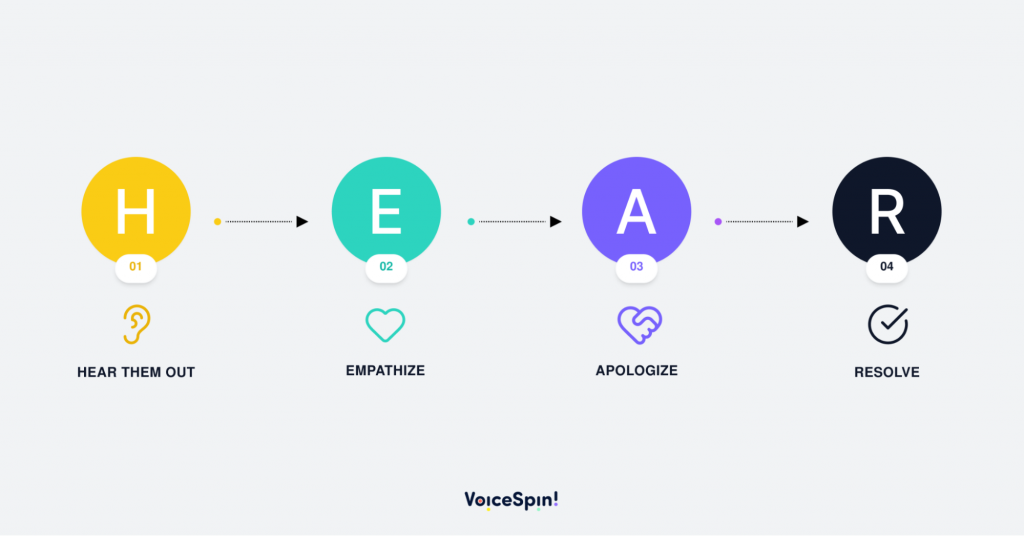
One structured approach for handling difficult customers that’s worked particularly well in call centers is the HEAR method:
- H – Let the customer finish speaking without interrupting
- E – Show them you get it – genuinely empathise with their situation
- A – Even if you didn’t cause the problem (and let’s face it, often you won’t), say sorry anyway and take responsibility
- R – Now sort out the issue or at least give them a clear way forward
This gives agents a bit of a safety net – a straightforward way to make sure they don’t skip any steps when dealing with a difficult customer.
4. Lead with Genuine Sympathy – It Matters
Being empathetic isn’t just nice to have – it’s a vital business tool. Research by Hiver shows that nearly 80% of customers want to deal with customer service reps who show they care. And if the customer feels understood and heard, they’re much more likely to feel good about the outcome even if the issue doesn’t get fixed the first time.
Train your agents to use specific, personal “I get where you’re coming from” statements rather than generic round-the-houses phrases. “Having to deal with this for the third time is really frustrating. I can see why” is a whole lot more effective than just saying “Sorry for any inconvenience”.
5. Take the Blame – Don’t Pass it On
When a customer’s getting angry, the last thing they want to hear is a list of reasons why it’s not your fault. They just want to know that someone’s taking responsibility and is going to sort it out. Agents who go on about other teams or systems losing trust the second they start making excuses.
So – train your agents to take ownership of the solution, even when they’re not the ones who caused the problem. Saying something like “I’m going to personally see to it that this gets sorted today” shows you’re accountable and builds trust, even in a tough situation.
6. Don’t Get Tangled Up in an Argument – Acknowledge and Move On
When customers get angry, it’s almost always a bad idea to try to fight back – or even to argue with them, even if they’re wrong. It just leads to more conflict and less chance of a good outcome. When agents get defensive, customers dig in and things get worse.
So – train your agents to acknowledge the customer’s point of view, even if they don’t agree with it. This way, they can keep the conversation on track and focused on finding a solution, rather than getting bogged down in a pointless argument.
7. The Anger Escalation Matrix – A Little Map to Help Guide You
Different customers need different levels of response – so it’s useful to have a bit of a map to help you figure out how best to respond. The anger escalation matrix is a good one to use:
- Low frustration (a bit annoyed): Just listen, empathise and sort out the issue
- Moderate frustration (pretty upset): Use the HEAR method, take responsibility and offer some options
- High frustration (very angry): Pull out the de-escalation script, slow down a bit and be prepared to escalate
- Extreme frustration (abuse/threats): Set some boundaries, escalate and move on
Training your agents to recognise which level they’re dealing with early on means they can start responding in the right way right from the off.
8. Offer Solutions – Give the Customer Choices
When customers get angry, they don’t want to hear about why things went wrong – they just want to know what’s going to get sorted. So shift the conversation from problem to solution as quickly as you can.
And – wherever possible – give the customer a choice. Saying “Here are two ways we can sort this for you” puts the customer in the driving seat and makes it much less likely they’ll get angry.
9. Know When to Pass It On – Escalation 101
Not every angry customer can or should be sorted out on the spot – sometimes you need to know when to escalate. So train your agents to recognise when a situation needs to be escalated and to pass the call on smoothly, without making the customer feel like they’re being fobbed off.
10. De-escalation 101 (When Things Get Really Tough)
When all else fails, and the customer is just getting too hard to handle – don’t panic. Just take a deep breath, pull out a de-escalation script and try to calm things down.A clear escalation process is crucial because agents need to be able to escalate quickly without having to think too hard about it, otherwise the customer will just have to go on and on telling the same story over & over again, and that just leads to a whole lot of wasted time. Agents should be able to hand the situation off to someone else in a way that keeps the customer happy, and makes sure that the next person in the chain is fully clued in on what is going on. Escalating does not equal failure – it’s actually a smart call (no pun intended).
11. Know How to Draw the Line With Difficult Callers
Agents are expected to handle tough interactions with professionalism, but there are times when it’s just not possible to turn the other cheek. There are some callers out there who are just plain abusive, and that’s never acceptable. These situations need to be cracked down on hard.
You need to set down clear policies that tell your agents how to handle abusive callers – when to give them a warning, when to hang up the phone, and how to document what’s been going on. The key thing is to make sure your agents feel confident and empowered to enforce those boundaries without being worried about getting in trouble for it.
It’s probably one of the best ways to get your call centre agents ready to deal with the tougher customers by having a load of ready-to-use de-escalation phrases for everyday situations. Here are six that you can use as a starting point , and have your team adapt for calls as they go along.
When a customer is getting worked up: “I totally get where you’re coming from – I want you to know that I’m right here to help resolve this issue for you right now. Can you tell me exactly what went down so I can get to the bottom of it?”
When a customer has been waiting far too long: “I’d be lying if I didn’t say sorry for the wait. We know that hanging around for ages is not how we want things to go, so I’ll make sure to get this sorted out for you personally.”
When a customer wants to talk to a manager: “I get where you’re coming from, and I’m totally happy to make sure you get the best help I can offer. Before I pass you on to someone else, I’ll do my best to sort this out myself, and if I’m not able to I’ll make sure your manager knows the whole story – so you won’t have to tell them all over again.”
When a customer is a repeat caller: “It’s clear that this has all been going on for a bit and I really am sorry you’ve had to ring up time and time again. That’s just not good enough. I’ll personally make sure this gets put to bed today and that you get a follow up to let you know the outcome.”
When you just can’t do what the customer is asking: “I’m sorry that’s not what you were hoping to happen , and I wish I could do more. What I can do is offer you [alternative solution]. I’m keen to make sure that this issue has been properly addressed.”
When a customer starts getting aggressive: “My goal is to help you fix this, and I’m going to do everything I can to do just that. I do need to ask , though, that we keep the conversation civil so I can focus on finding a solution that works for you”
How to Recover After Difficult Customer Calls
Dealing with tricky customers is bad news for your team – it’s an emotional, mental and physical drain. What’s just as important is how your team members recover after one of those calls. Here’s what you can do to help them.
Grab a short break when you can. Even a couple of minutes between calls can help your team clear their heads and start fresh with the next call rather than carrying all the stress from the last one.
Debrief with a supervisor or a colleague. Discussing what just happened helps your agents process it, figure out what went well, and spot what could be done differently next time. It’s a lot better than dwelling on it alone.
Keep the customer’s behaviour separate from who they are. Remind your team that customers who get upset are reacting to the situation, not the person on the other end of the line. This helps them not to take it to heart.
How AI Helps Call Centers Handle Difficult Customers in 2026
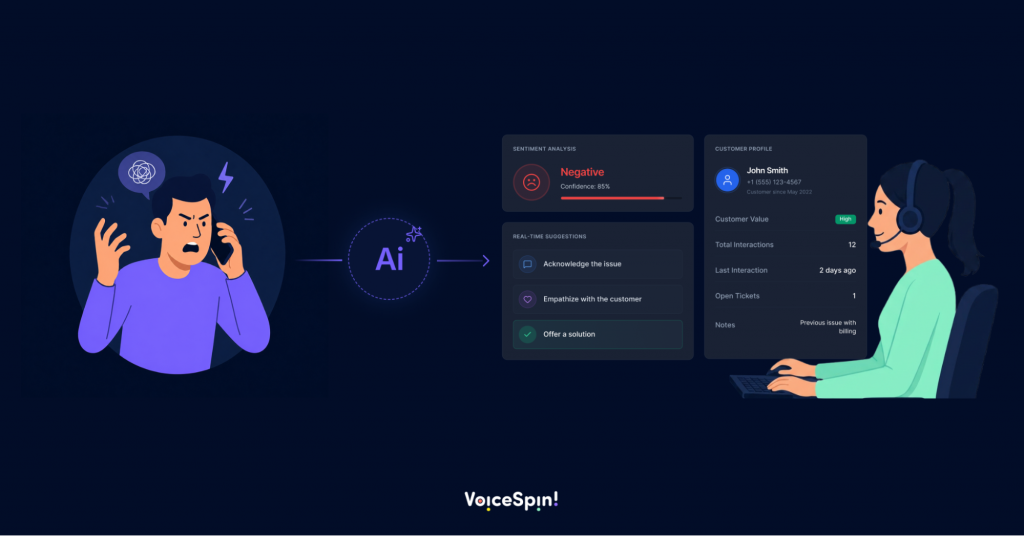
The right technology makes a big difference in how well call centers handle those tricky customer interactions. Here are the ways in which AI-powered tools can actually help support your team:
AI Speech Analytics
VoiceSpin’s AI Speech Analyzer monitors 100% of your calls automatically, analyzing sentiment, detecting keywords, and scoring interactions against custom KPIs. This means your QA team no longer has to rely on a 1-5% sample to understand how agents are handling difficult customers. You get complete visibility into every interaction, allowing you to identify coaching opportunities, spot recurring triggers, and intervene before a pattern becomes a problem.
Real-Time Agent Guidance
AI-powered systems can essentially give your agents a helping hand in real life conversations with customers. They’ll pop up with some ideas for how to respond or help the customer calm down – right in the middle of the call when it matters most. It helps agents know what to say and means they’re more likely to sort the problem out on the first try.
AI Voice Bots for Inbound Triage
VoiceSpin’s AI Voice Bot can handle a significant portion of inbound calls autonomously, resolving routine inquiries before they reach a human agent. This means agents spend less time on repetitive, low-complexity interactions and have more capacity to give their full attention to the difficult, high-stakes conversations that genuinely require a human touch – reducing agent burnout in the process.
CRM Integration for Full Context
One of the most common triggers for customer frustration is being asked to repeat information already provided. With VoiceSpin’s Salesforce integration and other CRM integrations, agents have a 360-degree view of the customer before they say hello – including previous interactions, purchase history, and open tickets. This removes one of the most common friction points in difficult customer calls entirely.
Intelligent Call Routing
Advanced call routing software matches incoming calls to the agent best suited to handle them based on skills, past interactions, and customer profile. When a known difficult customer calls back, intelligent routing connects them to the agent most likely to resolve their issue – reducing repeat contacts and improving outcomes for both the customer and the agent.
Frequently Asked Questions
How do you handle a difficult customer in a call center?
Stay calm, listen without interrupting, show empathy, take ownership, and shift the focus to solutions as quickly as possible. The agents who handle it best don’t argue – they just keep moving forward
How do you handle difficult customers in sales?
Dealing with difficult customers in sales is a bit of an art – it’s all about managing objections and keeping the relationship positive even when the sale falls through. When someone pushes back, just listen to what they’re saying, and then address their concerns without getting all defensive – if you can, suggest some alternative solutions and always leave the door open for a follow-up conversation.
What types of difficult customers do you usually come across in a call center?
The kinds of difficult people you’ll meet in a call centre are usually the ones who are angry or just plain fed up, the ones who are impatient and demanding an immediate fix, the ones who think they’re owed the world because of who they are, or the ones who don’t have a clue what’s going on. Then there are the repeat customers who just can’t seem to get it right and the ones who are just plain nasty.
What de-escalation techniques work to calm down a difficult customer?
The thing that really works is to – not interrupt them when they’re talking, use the HEAR technique to just make sure they feel heard, tell them you care with some genuine words of empathy, don’t pass the buck when you’ve got a solution, shift the focus from the problem to the solutions you’re offering and keep that control with the customer the whole way through the conversation.
How can AI actually help with handling difficult customers in call centers?
AI can really help out – like, for example, it can spot when a customer is getting upset and throw up a prompt to help the agent calm things down. Or, it can do some speech analysis on every call to spot patterns and trends, and then use that data to help train the agents. AI can also link the CRM to the call so the agent’s get all the background info before the call even starts, or do some of the simple stuff with voice bots so the human agents can focus on the tougher cases. And it can even route the customer to the agent who’s best placed to help them.
When do you know a difficult customer call needs to be escalated?
A customer call should be escalated if the issue just can’t be sorted out by the agent, if the customer asks for a supervisor, if it starts to get abusive or threatening, or if the agent runs out of options. The thing is, you need a clear process for escalating – it means the customer doesn’t have to jump through hoops all over again.


 +18889082995
 +442036084160
 +97237237006
 Call on WhatsApp

