

Call center compliance has never been more complicated – or more expensive to get wrong. By 2026, contact centers will have to navigate a veritable minefield of federal and state regulations, including TCPA, HIPAA, PCI DSS 4.0, and data privacy laws on top of a raft of AI-specific obligations that most teams are only just starting to wrap their heads around.
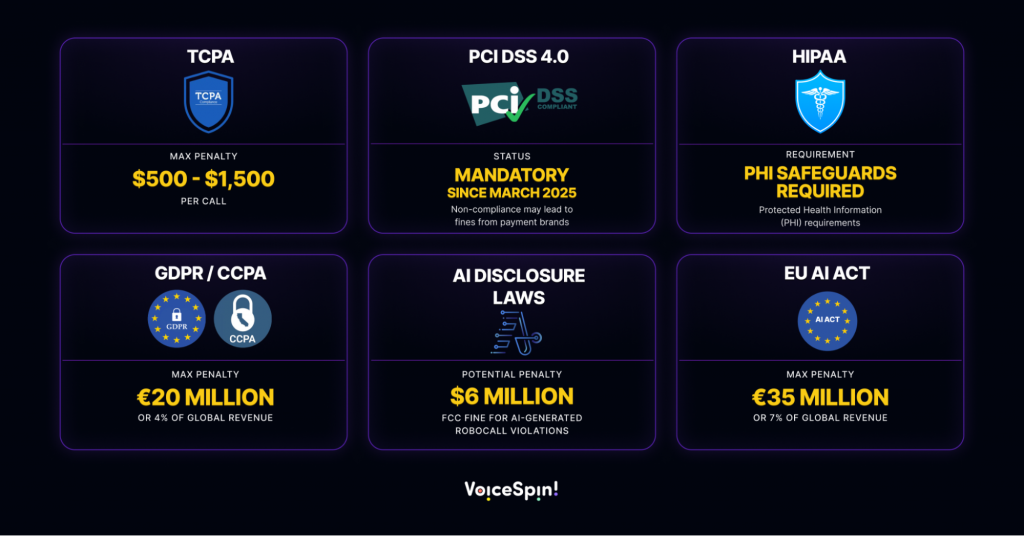
Getting it wrong will cost you big time. We’re talking ViSalus Inc. – $925 million in damages because they made over 1.85 million unsolicited robocalls in breach of the TCPA. Or the $6 million fine the FCC slung at some hapless political consultant for making dodgy AI-generated robocalls. And then there’s PCI DSS 4.0 – which became fully mandatory way back in March 2025, making all those call centers still running on older standards basically non-compliant.
This guide is here to walk you through everything you need to know about call center compliance in 2026 – from the key regulations and standards that apply to your operation, to some useful checklists, AI compliance requirements, and the tools that will help you stay on top of call center compliance.
What is Call Center Compliance?
Call center compliance is the body of laws, regulations, and industry standards that govern how contact centers collect, store, handle, and protect customer data, conduct outbound calling, record interactions, and train their agents to handle customer interactions.
Call center compliance bits and bobs vary slightly depending on the regulatory framework, but at its core, it means making sure every aspect of your contact center’s operation – from the way your agents answer the phone to how they handle payment info in call recordings – is up to scratch and meets whatever laws and standards apply.
And let’s be clear: non-compliance doesn’t just mean a slap on the wrist and a few extra months of auditing. It can damage customer trust, leave you open to lawsuits, and, in industries like healthcare and finance, even shut you down for good.
Why Call Center Compliance Matters in 2026
The compliance landscape for call centres has been turned on its head over the past couple of years, and 2026 is a critical time for contact centre regulatory compliance.
PCI DSS 4.0 is now a done deal. Those future-dated requirements that were due in 2025 are now the law of the land – and they include even stricter requirements around protecting cardholder data in call recordings – disk-level encryption no longer cuts it, for example.
TCPA consent rules have gotten tighter. The FCC’s one-to-one consent rule came in in January 2025, meaning you now need separate written consent for each seller – and web forms with pre-checked boxes no longer count as valid consent. To top it all off, you’ve got to honour opt-out requests within 10 business days from now on.
AI disclosure laws are already spreading their wings. Utah, California and Texas have already got AI disclosure laws on the books. And of course, the EU AI Act has taken full effect, with fines of up to €35 million for non-compliance.
Data privacy regulations are creeping into more and more places. CCPA/CPRA, GDPR and all those new state-level data privacy laws – they all apply outside your country of operation as well as inside, so if you’re dealing with customers from those places you’ve got to comply – regardless of where your call centre is.
Key Call Center Compliance Regulations in 2026
TCPA Compliance for Call Centres
The Telephone Consumer Protection Act (TCPA) is all about governing your outbound calling, text messages and automated dialling systems. TCPA compliance is one of the most significant areas of call centre regulatory compliance for any operation that makes outgoing calls to US consumers.
TCPA call centre compliance requirements in 2026:
- Get prior express written consent before using automated phone systems or pre-recorded messages for marketing calls or texts
- Maintain a do-not-call list and regularly update it, and cross reference it with the National DNC Registry
- Only call customers at permitted hours – usually 8am to 9pm in their time zone
- Honour opt-out requests within 10 business days across all channels
- Get separate written consent for each seller – one blanket consent no longer covers multiple companies
TCPA violations can cost you between $500 and $1,500 per call – a single non-compliant outbound campaign can generate six-figure fines in no time.
PCI DSS Compliance for Call Centres
PCI DSS (Payment Card Industry Data Security Standard) is all about how you handle cardholder data as a call centre. Call centre PCI compliance applies if your agents take payment card details over the phone – which is one of the most common sources of compliance violations that pop up during audits.
PCI call centre compliance requirements under PCI DSS 4.0:
- Never store sensitive authentication data after you’ve authorised payment
- Make sure any call recordings don’t capture cardholder data – either pause the recording when you do payment capture or use automated payment solutions that remove the agent from the payment flow entirely
- Implement strong access controls to limit who can access cardholder data
- Maintain network security controls including firewalls and encrypted transmission of cardholder data* Regularly conduct vulnerability assessments and penetration testing to stay on top of your call center’s security
- Train all the agents who handle payment data on the ins and outs of PCI DSS procedures
Call center PCI compliance checklists seem to get missed all the time – especially when it comes to unencrypted call recordings containing card numbers, lousy access controls, and a lack of regular agent training on PCI DSS procedures.
For call center PCI DSS compliance the most effective route is to deploy a payment solution that takes the agent out of the loop altogether during transactions – that way you eliminate the risk of them capturing card data in recordings or just plain writing it down
HIPAA Compliance for Call Centers
HIPAA ( Health Insurance Portability and Accountability Act) is one of those annoying regulations that applies to any call center dealing with protected health information (PHI) – that includes healthcare providers, insurance companies and any of your contact center staff that are processing patient data. Call center HIPAA compliance is one of the toughest regulatory hoops you can jump through
HIPAA call center compliance requirements are pretty straight forward
- Get a Business Associate Agreement (BAA) signed with any third party vendors who are handling PHI on your behalf
- Make sure you have some tech safeguards in place to protect PHI when its stored & transmitted
- Train all the agents who have access to PHI on the HIPAA rules & regulations
- Get your procedures in order for reporting & responding to PHI breaches
- Limit access to PHI to only the agents who actually need it to do their job
- Make sure any call recordings containing PHI are stored securely and can only be accessed by people who need to get at them
HIPAA compliance is the big picture – the BAA though is the contract that governs how PHI can be used and what your vendors are supposed to do – so that is something you should definitely check out when looking for a call center compliance solution or vendor
GDPR and data privacy compliance
GDPR applies to any call center dealing with data from EU residents , regardless of where your call center is located – come 2026 you will be expected to have GDPR compliance sorted along with a bunch of state level data privacy laws in the US – like CCPA / CPRA – and similar regulations in other countries too
Key GDPR call center compliance requirements include
- Getting explicit consent before you can collect & process people’s personal data
- Making sure customers are clear on how their data will be used
- Being able to honour data subject access requests & right to erasure requests within the allowed timeframes
- Only collecting data that is actually necessary – data minimisation is the name of the game here
- Keeping records of all your processing activities
- Ensuring any third party processors have data processing agreements in place that are GDPR compliant
AI Compliance in Call Centers
AI compliance is the newest and most rapidly evolving layer of call center compliance – most contact centers are still a little behind the curve on this one – which is worrying given the number of federal state & international regulations that now cover AI
AI in call center compliance requirements in 2026 include
- Being upfront with customers when they are interacting with an AI voice agent – some states now actually require this
- Making sure that any AI generated voice communications comply with TCPA consent requirements – the FCC has actually confirmed that this includes AI generated voice
- Auditing any AI tools used for speech transcription & analysis to make sure they are compliant with biometric data laws – like BIPA in Illinois and CIPA in California
- The EU AI Act actually bans workplace emotion recognition – that started on the 2nd of February 2025
- Having some human oversight and escalation paths for AI handled interactions
The real takeaway from recent case law is that companies that select or encourage the use of AI tools that record or process protected data may be held liable – not just the vendor – that makes vendor due diligence and contractual protections a priority for AI call center compliance
Call Center Compliance Checklist for 2026
Use this call center compliance checklist to assess your current compliance posture across all major regulatory frameworks :
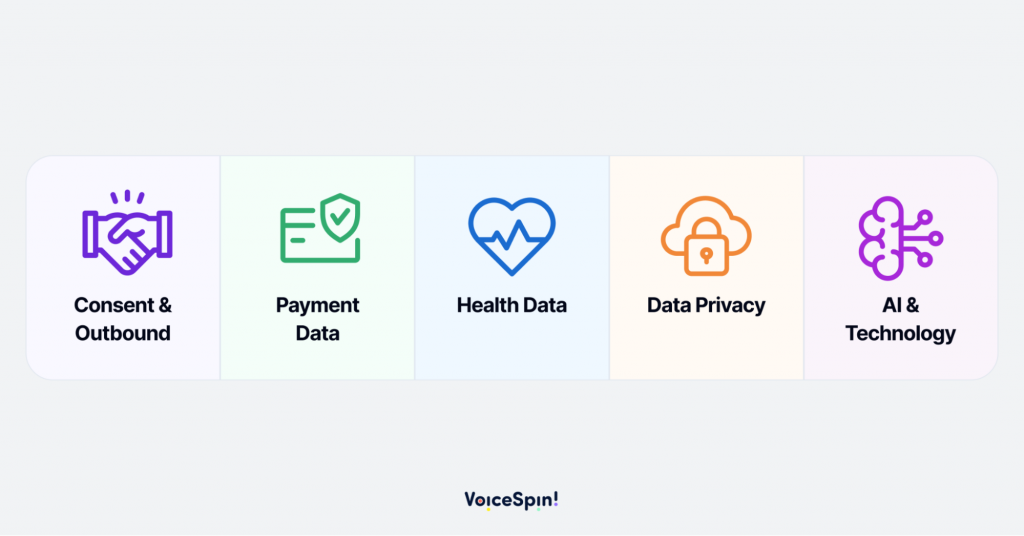
Consent & Outbound Calling – getting it right
- Is your Do Not Call list up to date and being regularly updated
- Have you got prior express written consent from customers for all outbound marketing calls
- Is consent being obtained one to one for each seller
- Is there a consent revocation process in place and being honoured within 10 business days
- Are your outbound calls restricted to allowed hours ( 8 am to 9 pm customer time zone)
- Are AI generated voice calls clearly disclosed as such
Payment Card Data (PCI Compliance) – keeping it secure
- Are call recordings paused or is the agent removed from the call during payment capture
- Is card holder data not being stored in call recordings
- Is access to card holder data restricted to authorised personnel only
- Are you doing regular vulnerability assessments
- Are your agents trained on PCI DSS requirements annually
Health Information (HIPAA Compliance) – HIPAA is no joke
- is a BAA signed with all vendors handling PHI
- Is PHI access restricted to authorised agents only
- Is PHI stored securely with encryption at rest and in transit
- Is agent HIPAA training conducted and documented
- Is a breach notification procedure in place
Data Privacy – getting it right
- Is customer data collection limited to what is necessary
- Are customers being provided with clear privacy notices before data collection
- Are data subject access requests & right to erasure requests being honoured within allowed timeframes
- Are third party data processors being bound by appropriate data processing agreements
AI & Technology – the new frontier
- Are customers being disclosed to before interacting with an AI voice agent
- Are AI generated voice communications compliant with TCPA consent requirements
- Are AI tools used for speech transcription & analysis being audited for compliance with biometric data laws
- A clear human escalation route is available for any issues that arise from AI interactions
- The contracts with AI vendors are reviewed to understand their liability and compliance obligations
Agent Training and Oversight
- Regular compliance training is carried out and recorded for every single one of our agents
- We make sure the policy on call recording and monitoring is clearly explained to both the agents and our customers
- 100% of our customer interactions are monitored for compliance (either fully automated or we randomly select a few to review manually)
- We take some time to make sure our escalation procedures are clearly defined and put to the test
Call Center Compliance Monitoring
Call center compliance monitoring is the process of systematically reviewing agent interactions to identify compliance violations, coaching opportunities, and process gaps. In 2026, effective compliance monitoring means moving beyond manual QA sampling to automated monitoring that covers every interaction.
Traditional QA programs review between 1% and 5% of calls. This means up to 99% of interactions are never reviewed for compliance violations. A single missed violation in a high-volume outbound campaign can result in significant financial exposure.
Modern call center compliance solutions use AI-powered speech analytics to:
- Monitor 100% of calls automatically for compliance keywords and phrases
- Flag interactions where agents deviate from required scripts or disclosures
- Detect when payment card data may have been captured in a recording
- Identify sentiment patterns that indicate potential TCPA or FDCPA violations
- Generate compliance reports automatically for audit purposes
VoiceSpin’s AI Speech Analyzer provides real-time keyword detection and sentiment analysis across every inbound and outbound call, giving compliance managers complete visibility into agent behavior and regulatory adherence without the limitations of manual sampling.
Call Center Compliance Management Best Practices
1. Build Compliance Into Agent Training From Day One
Call center compliance guidelines should not be treated as a separate track from standard agent training. Integrate compliance requirements into onboarding, refresher training, and role-playing exercises so agents develop compliant behaviors as habits rather than rules to remember under pressure.
Document all compliance training and maintain records of completion. In the event of a regulatory audit or litigation, training records are one of the first pieces of evidence requested.
2. Automate Compliance Monitoring
Manual QA sampling is no longer sufficient for effective call center compliance management in 2026. The combination of high call volumes, complex multi-regulation environments, and AI-specific requirements makes automated monitoring essential.
Automated compliance monitoring through AI speech analytics ensures that every interaction is reviewed, violations are flagged in real time, and compliance trends are visible across the entire operation rather than just the sampled subset.
3. Implement Pause-and-Resume Recording for PCI Compliance
One of the most common call center PCI compliance violations is the capture of cardholder data in call recordings. The simplest and most effective solution is implementing pause-and-resume recording that automatically pauses when payment data is being captured and resumes once the transaction is complete.
For maximum PCI call center compliance, consider deploying an automated payment solution that removes the agent from the cardholder data environment entirely during transactions – eliminating the risk at the source.
4. Maintain Detailed Consent Records
For TCPA compliance call center operations, consent records are your primary line of defense in the event of a complaint or litigation. Every consent record should include the date and time of consent, the channel through which consent was obtained, the exact consent language presented, and the caller’s phone number or identifier.
Store these records in a system that makes them easy to retrieve and audit. In the event of a TCPA complaint, being able to produce a timestamped consent record quickly can be the difference between a dismissed complaint and significant financial exposure.
5. Conduct Regular Compliance Audits
Call center compliance standards are not static – they evolve with new regulations, updated guidance, and enforcement trends. Schedule quarterly compliance reviews to assess your compliance posture against current requirements, identify gaps, and update policies and training accordingly.
A quarterly action plan approach – with four 90-day windows to address compliance gaps – is a practical framework for staying ahead of the regulatory curve rather than reacting to violations after they occur.
6. Vet Vendors Carefully
Courts have consistently ruled that compliance obligations cannot be outsourced. When your vendor violates TCPA, HIPAA, or PCI DSS rules, your organization pays the fine.
Before engaging any third-party vendor that handles customer data or conducts calls on your behalf, verify their compliance certifications (SOC 2 Type II at minimum), review their data processing agreements, confirm they have signed any required agreements (BAA for HIPAA), and assess their compliance training and monitoring practices.
How VoiceSpin Supports Call Center Compliance
VoiceSpin’s AI contact center software is built with compliance requirements in mind. Here’s how VoiceSpin helps call centers meet their regulatory obligations:
AI Speech Analytics for compliance monitoring: VoiceSpin’s AI Speech Analyzer monitors 100% of calls automatically, detecting compliance keywords, flagging deviations from required disclosures, and generating compliance reports – giving your QA and compliance teams complete visibility across every interaction.
Call recording with compliance controls: VoiceSpin’s call recording features support pause-and-resume functionality to prevent cardholder data from being captured during payment transactions – a critical requirement for PCI compliance for call centers.
CRM integration for consent management: With Salesforce, HubSpot, Zoho, and other CRM integrations, VoiceSpin enables centralized consent record management – ensuring that agent access to customer data is governed by the same system that tracks consent and communication preferences.
AI Voice Bot with disclosure capabilities: VoiceSpin’s AI Voice Bot can be configured to deliver required AI disclosures at the start of every interaction, ensuring compliance with state and international AI transparency requirements.
Call center QA software: VoiceSpin’s call center QA software enables compliance managers to build custom evaluation scorecards aligned to regulatory requirements, track compliance performance over time, and generate audit-ready reports.
Frequently Asked Questions
What is call center compliance?
Call center compliance is about sticking to the law – the legal, regulatory, and industry standards that say how contact centers have to handle customer data, deal with outbound calls, record conversations, and train their staff. Key call center compliance regulations include TCPA, PCI DSS, HIPAA, GDPR, and CCPA/CPRA.
What are the main call center compliance standards?
The big call center compliance standards include TCPA (which is all about consent for telemarketing), PCI DSS (which governs how you keep payment card details secure), HIPAA (which covers how you look after health data in healthcare contact centres), GDPR, CCPA/CPRA (which are all about keeping customer data safe) and the FDCPA (which governs the rules for debt collectors). But then in 2026, things got a whole lot more complicated with new AI disclosure rules popping up at a state and international level – so if you’re running a contact center with AI-powered agents, you’ve got another layer of compliance to worry about.
What is PCI compliance for call centers?
For call center PCI compliance, you need to adhere to the Payment Card Industry Data Security Standard (PCI DSS), which outlines how contact centers should handle, store, and protect cardholder data. That means keeping an eye on recordings to make sure you’re not accidentally recording people’s card numbers, keeping access to sensitive data tightly controlled, doing regular security checks, and making sure customer staff know what to do about PCI DSS – and under the latest rules, just using disk-level encryption to keep card details safe isn’t enough anymore.
What is HIPAA compliance for call centers?
HIPAA call center compliance is all about making sure you’re doing the right thing when handling protected health information on behalf of healthcare providers, insurance companies, or other organizations that must follow HIPAA rules. That means signing a Business Associate Agreement with any vendors that handle health info, implementing sensible technical and administrative safeguards, training your staff on HIPAA, and making sure you know what to do if something goes wrong.
What is TCPA compliance for call centers?
TCPA compliance for call centers means you’ve got to stick to the rules around making outbound calls and texts, which are laid out in the Telephone Consumer Protection Act – that includes getting people to agree to receive marketing calls and texts, keeping an eye on the national ‘do not call’ lists, and not calling people outside allowed times. And to make things even trickier, from 2026 you’ve also got to get written consent from people before you start sending them automated voice messages via AI – and if you mess this up, you could end up being fined between $500 and $1,500 per call.
What is a call center compliance checklist?
A call center compliance checklist is a list of everything you need to do to make sure you’re not getting fined or sued – in other words, it covers all the key regulatory requirements that apply to your business. If you’re running a call centre in 2026, your compliance checklist should cover TCPA consent, keeping an eye on the ‘do not call’ lists, PCI DSS requirements for secure data storage, HIPAA rules for handling health data, data protection laws, AI disclosure rules, training for your staff.
How does AI help with call center compliance?
AI can be a real game-changer when it comes to call center compliance – it can help you stick to the rules in a whole bunch of ways. For a start, it can automatically listen to 100% of your calls to catch any problems and give you real-time alerts, use keyword detection and sentiment analysis to pick up any issues, automatically flag up any times when agents have strayed from the script or failed to disclose something, and even help you check your compliance across your whole call volume rather than just a random sample. And with tools like VoiceSpin’s AI Speech Analyzer, compliance managers can finally gain the visibility they need into what’s happening with their staff and whether they’re sticking to the rules.

 +18889082995
 +442036084160
 +97237237006
 Call on WhatsApp

