
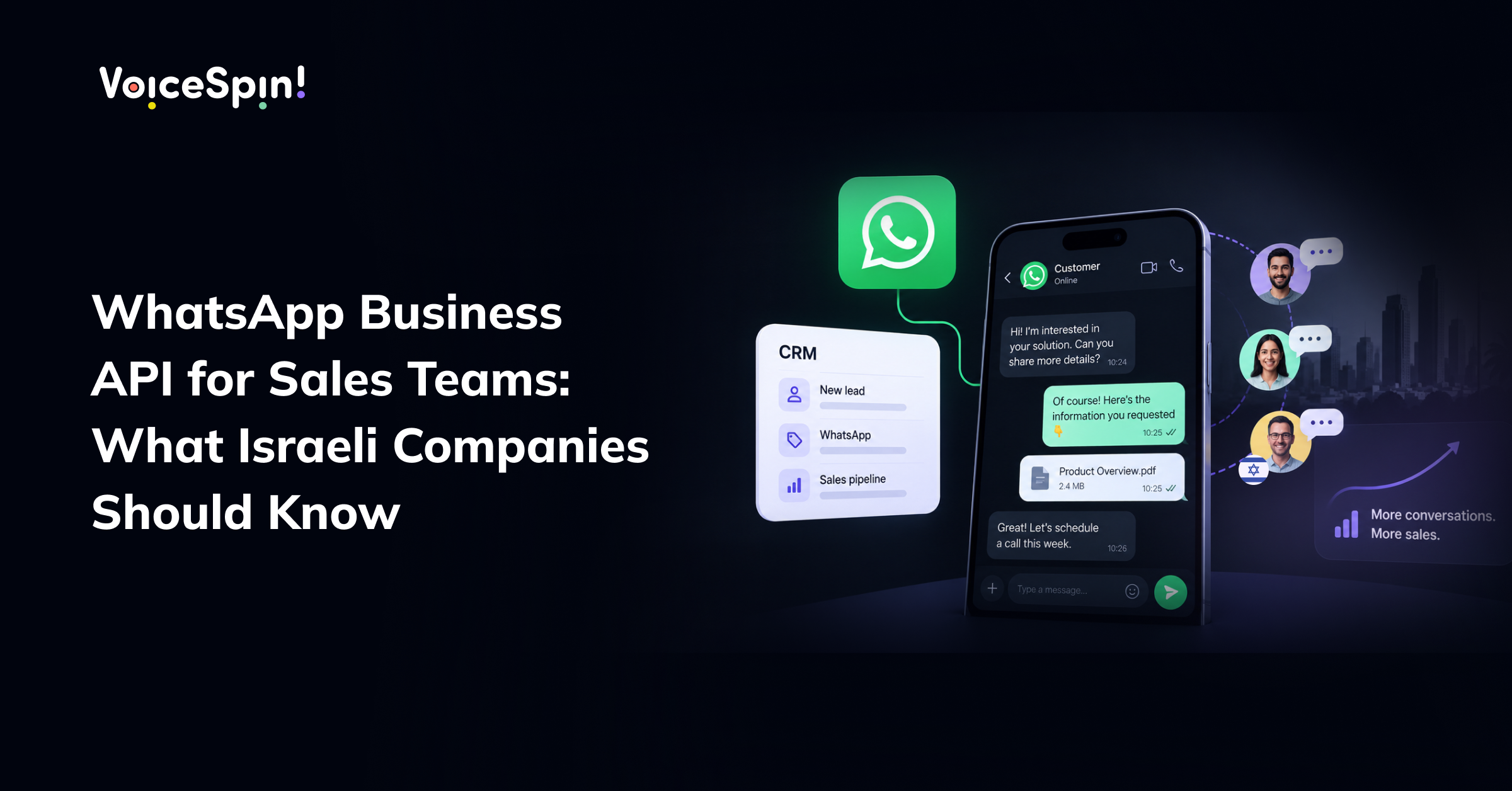

In Israel, WhatsApp is not just a messaging app. It is where customers talk to friends, family, colleagues, and increasingly, the businesses they buy from. For sales teams, that makes WhatsApp one of the most direct routes to a prospect’s attention, often far more effective than email or an unanswered phone call.
Still, plenty of Israeli businesses are running their WhatsApp sales – and contacting customers, for that matter – through the standard WhatsApp Business app or their reps’ personal phones. That’s where the WhatsApp Business API comes in – officially known as the WhatsApp Business Platform, it was built specifically to solve the visibility, compliance, and continuity problems that come with growth.
WhatsApp Business App vs WhatsApp Business API
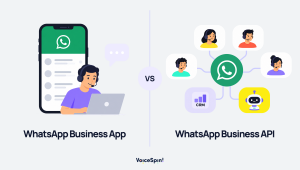
The WhatsApp Business app is great for small businesses that manage conversations from one or two phones.
The WhatsApp Business API is designed for companies that need WhatsApp to work as part of a broader sales and service operation. It allows many reps to handle conversations from one verified business number, connects WhatsApp to the CRM and contact center platform, supports approved message templates for outbound communication, and enables AI agents to respond automatically at any hour. Access is provided through Meta directly or through a solution provider that integrates the API into existing business systems.
Why WhatsApp Matters for Israeli Sales Teams
Getting back to customers fast is a pretty good indicator of whether a lead is going to convert – and on WhatsApp, Israeli customers expect lightning-fast responses. A prospect who fills out a form or clicks on an ad is far more likely to engage with a WhatsApp message in minutes than a callback the next day.
Prospects can share documents, ask questions at their own pace, and come back to the conversation later without losing any context. For B2B sales in particular, where decisions involve several stakeholders and multiple follow-ups, that continuity is extremely valuable.
Key Sales Use Cases for the WhatsApp Business API
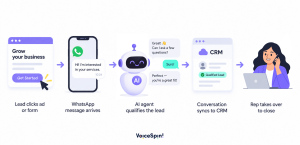
Instant lead response. When a new lead comes in from a form or a click-to-WhatsApp ad, an AI agent can respond instantly, ask questions, and route the conversation to the right rep with all the context from the CRM.
Appointment and demo scheduling. Reps and AI agents can offer time slots, confirm meetings, and send reminders through approved templates. That helps reduce no-shows significantly.
Structured follow-ups. Quotes, proposals, and product information can be shared straight in the conversation, and follow-up messages can be automatically scheduled depending on where each prospect is in the pipeline.
Seamless handoff between AI agents and reps. Questions about pricing tiers, integrations, or availability can be answered by AI agents, while conversations that need serious negotiation or expertise move to a rep without the customer having to repeat anything.
Consent and the Israeli Anti-Spam Law
Before using WhatsApp for outbound sales, Israeli companies need to understand Section 30A of the Communications Law, commonly known as the Anti-Spam Law. The law prohibits sending advertising messages by electronic message, SMS, email, fax, or automatic dialing system without the recipient’s prior explicit consent. Consent can be given in writing, by electronic message, or by recorded call.
The consequences of non-compliance are significant. Courts may award damages of up to 1,000 NIS per message without any proof of harm, and class actions under the Anti-Spam Law have become increasingly common in Israel. Courts have also tended to interpret the definition of advertising broadly, so messages that encourage a purchase, offer a discount, or promote a service are likely to fall within its scope.
In practice, that means sales teams should be collecting documented opt-in consent at every entry point, storing it in the CRM, and using the WhatsApp Business API’s template and opt-out features to keep all that outbound activity compliant.
Understanding WhatsApp Business API Pricing in 2026
Meta has changed WhatsApp Business Platform pricing several times over the past two years, and another major change takes effect on October 1, 2026.
Since July 2025, Meta has charged per delivered template message rather than per conversation. Template messages fall into categories such as marketing, utility, and authentication, each with its own rate that varies by country. Until now, replies sent within the 24-hour customer service window, known as service messages, have been free.
Starting October 1, 2026, service messages sent within the customer service window will be billed per message, regardless of whether they are sent by a rep or by a third-party AI agent. Utility templates sent inside an open service window will also become billable. Conversations that begin through eligible free entry points, such as click-to-WhatsApp ads, continue to benefit from an extended free messaging window.
Connecting WhatsApp to Your CRM and Contact Center
The full value of the WhatsApp Business API appears when it is connected to the rest of the sales stack. When WhatsApp conversations sync automatically with the CRM, reps can see every previous interaction – whether it was a phone call, an email, or a WhatsApp conversation – and managers can measure the channel’s contribution to the pipeline accurately.
An integrated contact center platform takes it a step further by bringing voice calls and WhatsApp conversations into one workspace. Decathlon Israel is a great example of this approach. By combining the VoiceSpin AI call center with a WhatsApp AI chatbot that is integrated with Zoho CRM, the company can now serve around 700 customers a day, while freeing up 50 percent of its reps’ time for conversations that actually need their expertise.
Getting Started With the WhatsApp Business API
A successful rollout usually begins by defining the sales use cases WhatsApp will support, such as lead response, scheduling, or follow-ups, and deciding where AI agents will handle conversations and where reps will take over. The next step is completing Meta business verification, choosing a solution provider, and connecting the API to the CRM so that every conversation is recorded from day one.
Before launching outbound activity, companies should review their consent collection process against the Anti-Spam Law, prepare and submit message templates for approval, and train reps on tone, response time expectations, and compliance. Once the channel is live, tracking response times, conversion rates, and message costs will show where the process can be refined.
Conclusion
The WhatsApp Business API gives Israeli sales teams a way to meet prospects on the channel they already prefer, with the structure, visibility, and automation that personal phones and the standard app cannot provide. At the same time, it demands careful attention to consent under Israeli law and to the evolving pricing model, especially with the October 2026 changes approaching.
Companies that approach WhatsApp as an integrated part of their sales and contact center operation, rather than as a standalone chat tool, are best positioned to turn faster conversations into stronger results. VoiceSpin helps Israeli businesses build that integration through AI-powered voice and messaging solutions connected directly to the systems their teams already use.
Frequently Asked Questions
What is the difference between the WhatsApp Business app and the WhatsApp Business API?
The WhatsApp Business app is pretty much for small businesses that manage conversations from just one phone or possibly a few phones they have linked. The WhatsApp Business API allows many reps to work from one verified business number and integrates with CRM and contact center systems. It supports approved outbound templates and enables AI agents to handle conversations automatically.
Is it legal to send sales messages on WhatsApp in Israel?
Sending advertising messages on WhatsApp is permitted when the recipient has given prior explicit consent, as required by Section 30A of the Communications Law. Limited exceptions exist, such as a one-time consent request to a business recipient, and every advertising message should include a clear way to opt out. Companies should consult legal counsel for guidance on their specific outreach model.
How much does the WhatsApp Business API cost?
Meta charges per delivered template message, with rates that vary by message category and country. From October 1, 2026, service messages sent within the 24-hour customer service window, as well as utility templates sent inside that window, will also be billed per message. Solution providers may add their own platform fees on top of Meta’s rates.
Can AI agents handle sales conversations on WhatsApp?
AI agents can respond to new leads instantly, ask qualifying questions, share product information, and schedule a meeting at any time of day. When a conversation gets too deep or complex for an AI to handle, it’s pretty easy for it to pass that conversation along to a human rep – and the human gets the whole conversation history to boot, so the customer never has to repeat themselves.
Can the WhatsApp Business API integrate with our CRM?
Yes, the WhatsApp Business API can be connected to most major CRM platforms, either directly or through a contact center solution. This allows every conversation to be logged automatically, gives reps full customer context, and helps sales managers see the impact that WhatsApp has on the pipeline.

 +18889082995
 +442036084160
 +97237237006
 Call on WhatsApp

