

Call center reps are the ones on the front line dealing with customers, sorting out problems and acting as the face of their company – but the nature of that role is changing faster than you can keep up with.
By now, AI has moved from being a nice-to-have in call centers to being an integral part of how they operate. It’s now a key tool for directing calls, summarising conversations, evaluating the performance of reps and helping train them up. We’re no longer asking whether AI is going to change this role – we’re now asking what it means for the people doing the job.
Why the Traditional Model Fell Apart
The traditional call center model was built on a simple principle: hire enough people to cover the volume. If it got bigger, you hired more staff. If quality started to slip, you added supervisors. But when your reps got burnt out from constantly doing the same thing -, you just had to start recruiting again.
But customers have got much higher standards for call centers than that. They want quick responses, seamless handovers between all the different channels and personal support – which high-volume workflows just can’t deliver.
At the same time, call centers are struggling with a whole load of internal issues – like high staff turnover, and the nightmare of scaling up during busy periods without having to hire loads more staff.
According to a 2024 Salesforce survey, 67% of customers are happy to let AI deal with their queries. And a year ago, McKinsey found that companies which had invested in AI for customer service had seen 20-30% reductions in waiting times for customers.
Gartner reckons that about 50-60% of incoming calls are routine – so password resets, order status checks, or appointment confirmations. And that means they’re ideal for automation, without needing humans to get involved.
Why AI Is Very Effective for Call Centers
A lot of people think AI in call centers means replacing humans with chatbots – but the reality is that automation is designed to replace the bits where it makes sense:
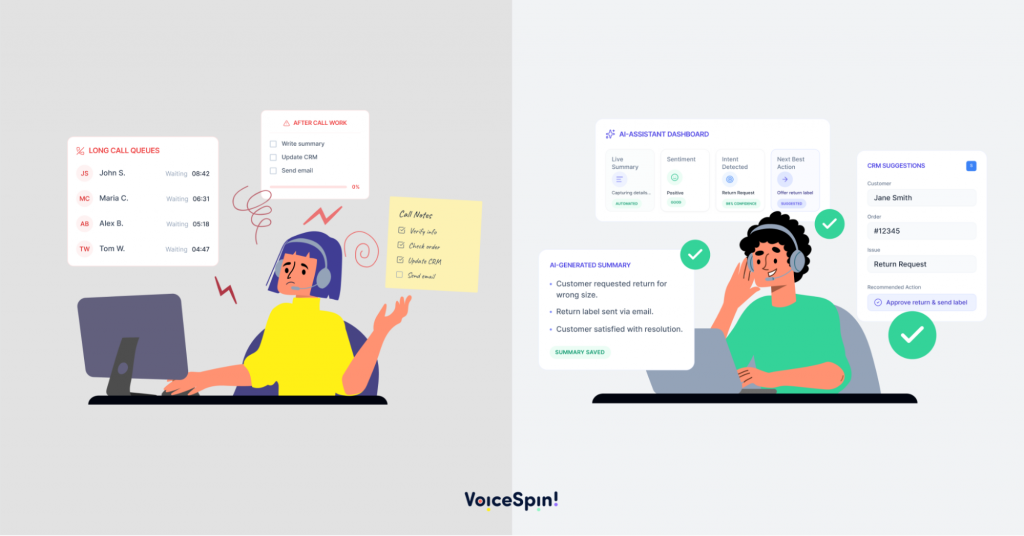
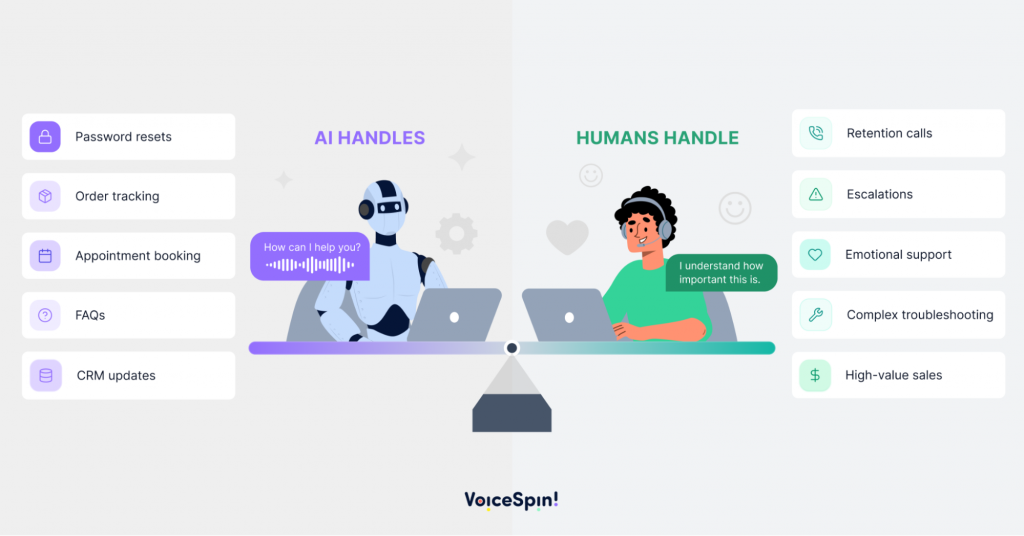
- Routine inward interactions. AI voice bots can now manage hundreds of simultaneous calls for general questions, account look-ups and scheduling appointments. All this gets logged into the CRM system so the customer can get a resolution without needing to speak to a human.
- Post call work. Traditionally, teams spent hours updating the CRM records after each call, writing a summary and flagging follow-ups. AI can now take care of all that, and significantly reduce the amount of after-call work.
- Quality control. In the past, QA teams could only review a limited number of calls. Now AI speech analytics platforms can review almost all conversation volume and automatically flag any issues around compliance or things that need coaching. Which means supervisory sessions are now all about drilling down on the calls that really need attention.
- Predictive routing. Rather than sending the caller to the first available human rep, AI can now use data about the customer’s past behaviour, the type of issue they are likely to have and the rep’s past performance to make a better match. Which will give a big boost to first-call resolution rates.
- Real time assistance. While the team is on the phone, AI can bring up relevant CRM data, suggest responses based on past calls, and prompt the reps with what to do next. So reps can focus on doing the right thing, rather than trying to remember what to do.
A Real World Example: Redesigning the Role Around AI
A mid-sized carrier did a 2025 Zendesk CX Trends case study on how they used AI to handle order tracking and returns – previously making up 58% of their inbound calls. Within 90 days, automation had resolved 71% of those interactions without needing a human to get involved.
Instead of axing the team, the company got them working on retention calls for customers who were about to cancel, and follow-ups after a purchase. Customer satisfaction went up by 14 points in just six months – and average handle time on escalated calls fell by 22%.
The result? The reps were doing a fundamentally different job.
The Shift to Higher Value Conversations
As AI takes over the transactional stuff, teams are shifting towards the kinds of interactions that require human judgement: escalated complaints, retention calls, complex troubleshooting and high-value sales.This represents a massive change in what’s expected from the job. Figuring out how to reset a password is pretty routine – it’s just following a procedure. But persuading a customer who wants to cancel from sticking around, or trying to troubleshoot an issue with someone who’s partly being let down by the company – that demands empathy, good judgement, and the kind of communication skills that AIs are still a long way from being able to match.
The people who excel in this kind of environment aren’t always the ones who can fly through the routine tasks at top speed – they’re the ones who genuinely connect with every customer, tailor their message and adapt their tone on the fly, and make sound decisions without having to fall back on a script.
Qualtrics research from 2024 puts it this way : this is all about augmenting reps with AI, not replacing them – it’s a pretty fundamental shift in what reps are being asked to do and what kind of support they need while doing it.
How AI Is Changing the Skills Reps Need
The core skills that make a great representative – empathy, active listening, communication, resilience – are still the foundation. However, the surrounding skill set is starting to expand in all sorts of ways.
Technical fluency is fast becoming a key differentiator. You see, reps who are familiar with working alongside AI tools, can take a critical look at suggested responses, and know their way around a CRM integration are a cut above the rest. They get things wrapped up a heck of a lot faster and can personalize their conversations in a way that’s hard to match.
Judgement over procedure. As AI takes care of the routine, scripted stuff, it leaves reps to deal with all the situations that don’t fit neatly into some pre-defined decision tree. And it’s not hard to see why the ability to make sound judgement calls in all those messy situations – with no script to fall back on – is getting more valuable by the day.
Coaching receptiveness – AI can now spot patterns across thousands of calls and highlights all sorts of coaching opportunities. Reps who are open to that feedback are going to improve way faster. The ones who aren’t – well, they’ll just fall further and further behind their colleagues.
Companies that take the time to help their reps get up to speed on these new skills, alongside the AI tools that are now such a big part of the job – are seeing much better retention rates. But companies that just slop the AI on top of their old workflow, without so much as a thought to adjusting their training or support structures – well, they’re just not getting the same kind of gains.
Will AI Replace Call Center Reps?
There’s no straight answer to that. It depends on the type of role we’re talking about.
Highly transactional roles, the ones that are all about tier-1 queries – they’re under some serious pressure from automation. Some of that headcount is already being cut back.
But a SurveyMonkey survey found that only 8% of consumers would actually prefer to deal with an AI over a human in a complex or emotionally charged service interaction. And when it comes to escalations, complaints, retention, and high-value sales – well, they’ll still want a human every time. And what we’re seeing is that there’s a quality difference that comes with using a human – in terms of conversion rates and NPS.
You see the contact centers that are struggling the most – it’s not the ones that have adopted AI. It’s the ones that have adopted AI without really thinking about where it adds value, and where human judgement is still needed.
What Businesses Should Prioritize
The question isn’t “how much can we automate?” It’s: which interactions genuinely benefit from a bit of automation and which ones really suffer from it?
Effective AI deployment in contact centers tends to follow a certain pattern: automate routine inbound volume, knock down the amount of post-call admin work, use the analytics to spot coaching gaps, and then redeploy that reps capacity towards higher-value conversations.
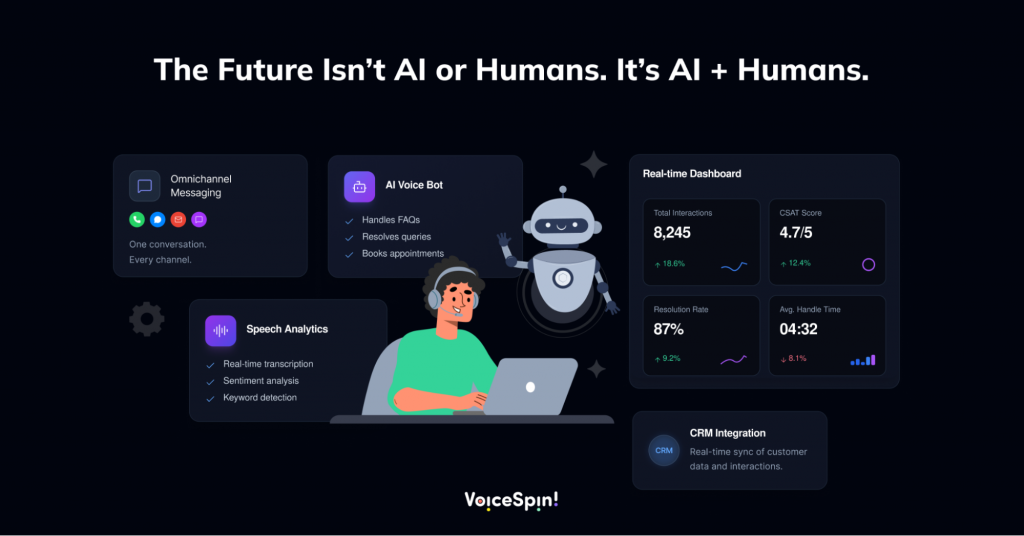
That takes more than just a standalone chatbot. You need an integrated platform where the AI voice, messaging and analytics, and CRM systems all work together – so that a customer who starts off with an AI bot and then escalates to a human representative doesn’t have to repeat themselves.
The competitive advantage isn’t in maximising automation. It’s in building a system where the AI and human reps each handle what they’re best at – and where that’s actively managed, not just left to chance.
Frequently Asked Questions
How is AI changing the day-to-day work of call center reps? Well AI is automating some of the more mundane stuff like call routing, and answering FAQs and updating CRM. It’s also cutting down on the administrative overhead that used to soak up so much of a rep’s time. And in real time, it can surface relevant data and suggest responses during live calls – so reps can focus on the conversation rather than just managing the information.
What is call calibration in a BPO, and how is AI changing it? Call calibration is that quality control process where supervisors and reps listen back to the same call and then compare their scores on quality standards. Traditionally it was a pretty small sample of calls. But now AI speech analytics can process close to 100% of the call volume automatically. That means the calibration process can be targeted at just the interactions that need it.
Will AI replace call center reps? Well, transactional-only roles are under automation pressure. But roles that require emotional intelligence, complex problem-solving, and high-stakes conversations – they’re still very much human-dependent. Most contact centers are restructuring to get more of those roles and less of the ones that are getting automated.
What new skills do reps need as AI becomes more integrated? Well, it’s not just about the core skills of communication and empathy anymore. Reps need to get to grips with AI tools and CRM systems. And they need to be able to exercise their own judgement in all those ambiguous situations where there’s no script to fall back on.
What are the measurable benefits of AI in contact centers? Well we’re seeing reductions in average handle time of 20-30%, near 100% QA coverage, and significant cuts in after-call work time. Customer satisfaction improvements are all over the map – it really depends on how well the AI deployment is done, and how the reps’ workflows are redesigned alongside the technology.

 +18889082995
 +442036084160
 +97237237006
 Call on WhatsApp

