

A few years ago, companies looking to upgrade their contact center were asking the same question: what phone system are we going to use? And the answer the market gave them was, in turn, cloud telephony, then omnichannel solutions, and finally chatbots added on top.
By 2026, the question has shifted. Buyers aren’t comparing phone systems anymore. They’re comparing AI architectures.
That shift is significant because it completely changes what contact center software is supposed to be doing. The platform becomes a place where conversations get understood, routed, automated, and improved. And communication is becoming a standard commodity. The real juice is coming from the intelligence layer which is what’s become the true product.
This guide will break down what modern AI contact center software looks like in 2026, what’s changed in the last year, and what to look out for when evaluating a platform that you’re currently considering.
What’s an AI Contact Center Platform in 2026
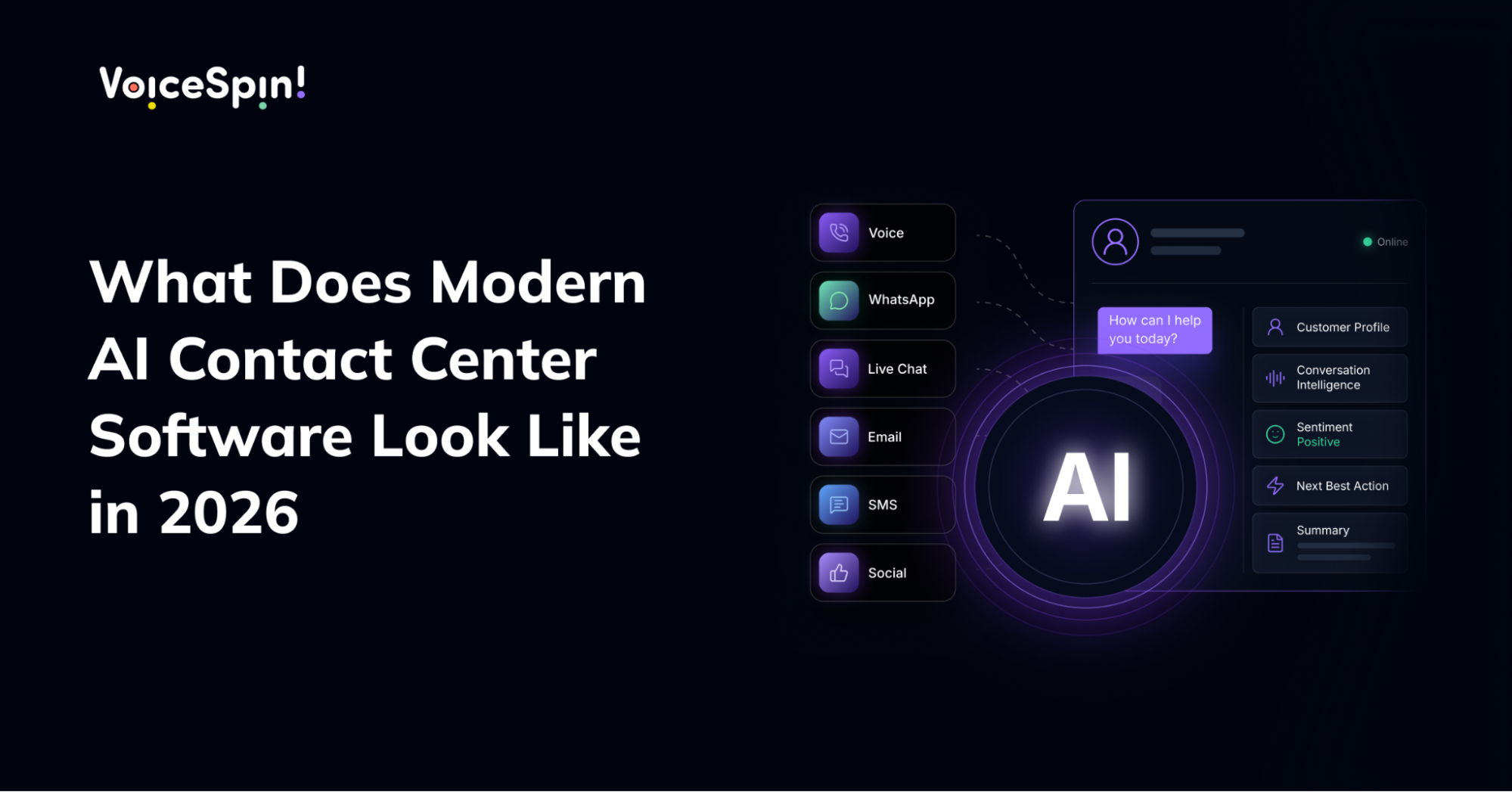
An AI contact center software is a unified communication platform that brings together voice, messaging, CRM, analytics, and automation all under one AI layer that processes every interaction – no matter the format.
So what are the components that most buyers are now expecting to see in one platform?
- AI powered voice bots and AI driven chatbots
- Omnichannel messaging – voice, WhatsApp, SMS, email, live chat, and social media
- Proper two-way CRM integrations
- AI powered speech analytics and conversation intelligence
- Predictive and power dialers
- Workflow automation
- Cloud telephony with global reach
The thing that’s changed is how these bits relate to each other now. In 2022, they were separate tools that had to be connected up with integrations. In a 2026 setup, they’re more like surfaces on a shared intelligence layer that can retain context across every single interaction.
That distinction between AI-powered and AI native is the biggest variable in whether a platform is actually going to deliver real operational gains in production.
Why customer expectations have gone beyond what traditional contact centers can handle
The figures alone show just how fast this shift is happening.
Salesforce’s State of the Connected Customer research found that 88% of people now say that the experience a company provides is just as important as its products or services – the highest figure ever recorded by the survey. Customers expect to move seamlessly between phone, WhatsApp, email, and live chat without having to go over the same ground all over again. They expect responses within minutes – not hours – and they expect the agent on the other end to already know who they are.
The traditional contact center setups just weren’t built for this. They were built around channels with each channel running on its own system. Agents have to juggle lots of different tabs. Context gets lost between handovers. Quality assurance reviews a tiny sample of conversations and then extrapolates the rest.
The operational cost is quite significant too. Across different industries, businesses are missing between 20% to 49% of inbound calls – auto service centers are missing about 20%, insurance companies about 39%, and banks and lenders are coming in at close to 49%. Each call that gets missed is a missed lead, a frustrated customer, or a churn signal that never gets noticed.
Modern AI contact center software is designed to close this gap by automating all the layers that traditional setups required agents to manage manually.
How speech analytics has changed in two years
The biggest operational change that’s come to contact centers over the last two years? It’s barely even been marketed: AI speech analytics has finally reached the point where it can analyse every single conversation automatically, not just a tiny sample.
Traditional QA programmes review somewhere between 1% and 5% of calls. Every claim about agent performance, customer satisfaction, and compliance was based on tiny data. Coaching decisions, performance reviews, and training programmes were all built on assumption.
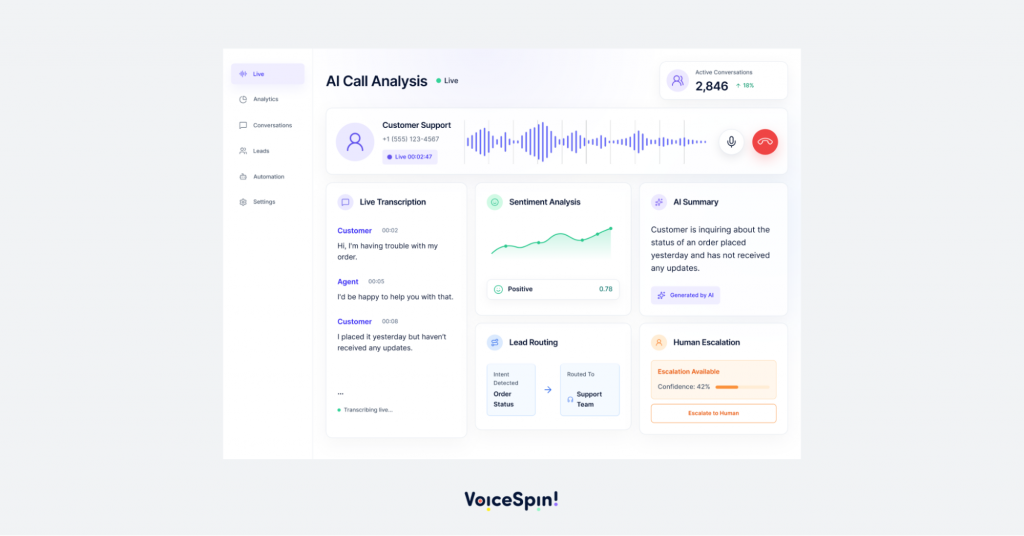
Modern platforms can now run real-time transcription, sentiment analysis, topic detection, keyword spotting, and AI-generated summaries across every interaction automatically. Questions that used to be unanswerable – like which agents handle pricing objections best, what’s driving our churn this quarter, and where are we at compliance now? – become simple queries instead of guesses.
McKinsey’s 2025 analysis found that companies deploying AI agents in contact centers can cut the cost per call by 50% while CSAT goes up, and AI enabled self-service can reduce incident volume by 40-50% with cost to serve reductions over 20%.
When evaluating an AI contact center platform in 2026, the question to ask isn’t whether it has speech analytics. The real question is how much of your conversation volume the analytics layer can process and what it costs to scale.
AI voice bots have finally crossed the production threshold
For years, AI voice was impressive in demos but completely unreliable in real customer environments. But the real world has a way of throwing up all sorts of noisy audio, accents, interruptions, latency, and unpredictable conversation flows that early voice bots just couldn’t handle.
However, modern AI Voice Bots can now simulate natural conversations, adapt to interruptions, understand intent across different languages and accents, grab contextual information from your CRM and knowledge bases in real time, and escalate with a level of intelligence when confidence starts to drop. They’re rolled out in live environments for tasks like inbound triage, outbound qualification, appointment setting, FAQ handling, and handing out leads.
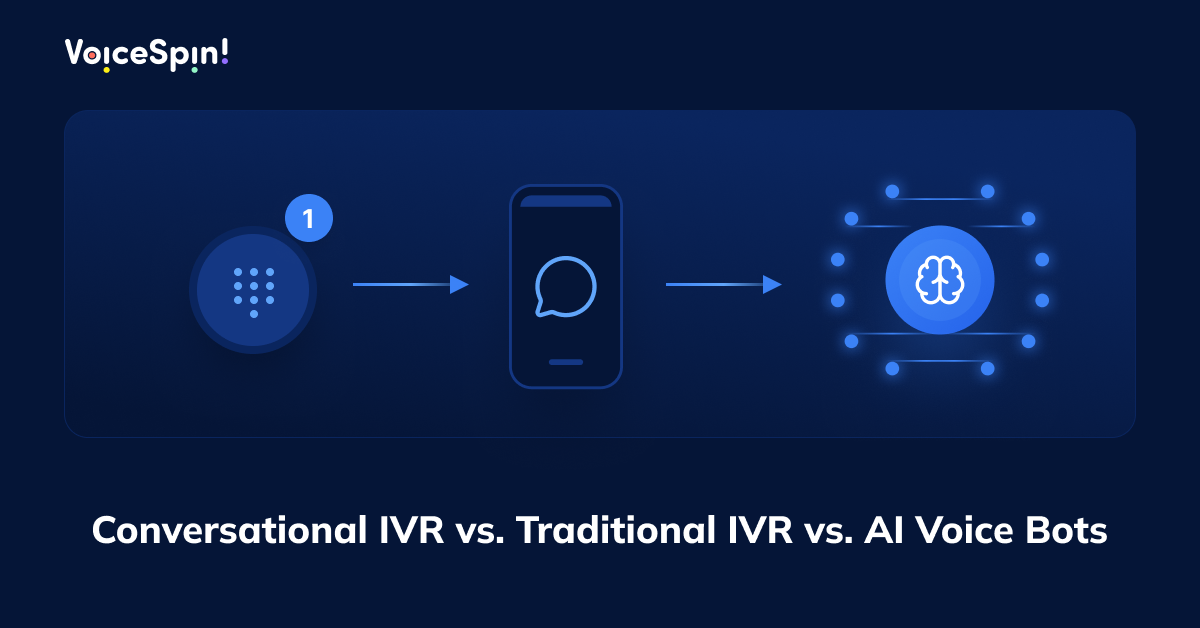
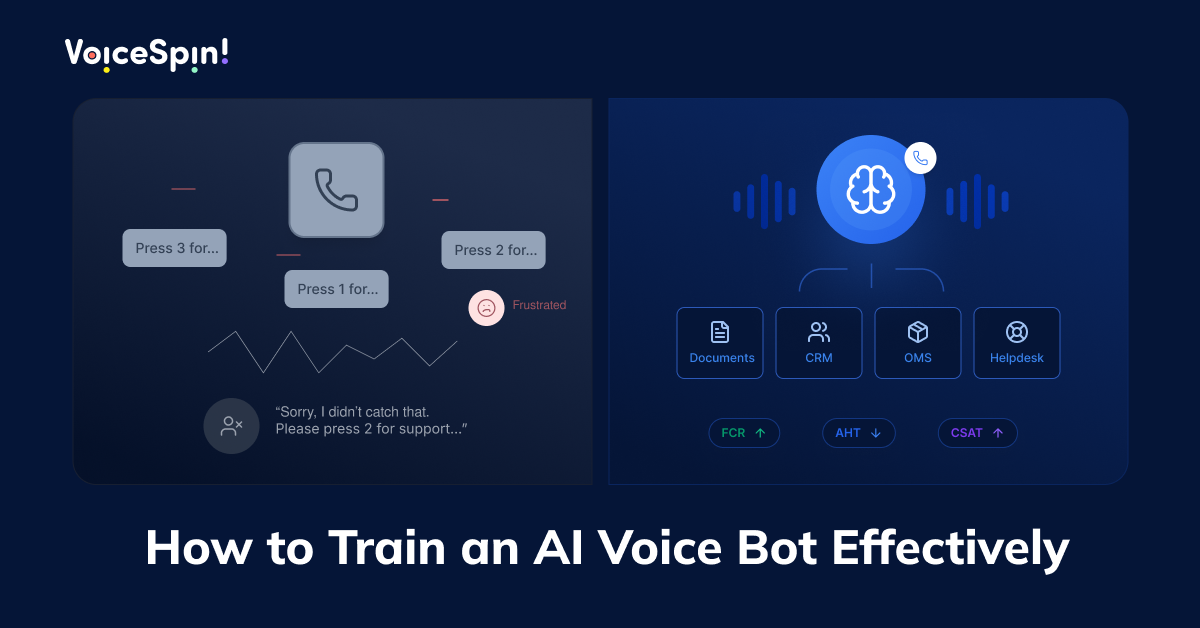
The difference between traditional IVR and a modern AI Voice Agent is clear. An IVR plays a script, whereas the AI Voice Agent engages in a conversation, pulls context from CRM, and decides whether to handle the request or pass it to the human agent.
By 2026, buyers won’t be impressed with the demo version of AI performance – they’ll want to know whether the system can hold conversations with thousands or even millions of customers itself. Latency, transcription accuracy across languages, escalation handling and CRM sync stability are all the things that will now set a system apart.
Omnichannel is now about continuity, not just being multi-channel
A few years back, omnichannel was about being able to support multiple channels. But in 2026, it’s a bare minimum. The hardest thing most contact center platforms still do wrong – is getting continuity between channels.
Customers switch between voice, messaging apps, email, and live chat depending on the situation, and it frustrates them that they are losing context every time they move to a new channel. What they need is a seamless experience that carries on from one channel to the next.
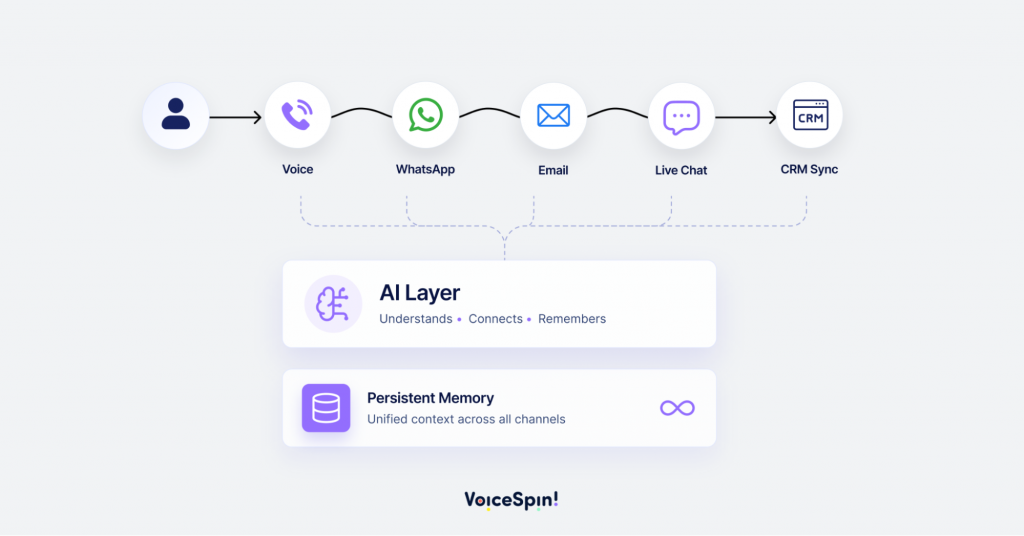
Modern AI Contact Center Platforms have cracked this by having persistent customer memory and conversation continuity layers. The voice bot can see what was discussed in yesterday’s live chat, and the next agent can see a summary of this morning’s call. The CRM record updates in real time, no matter which channel the conversation was on.
The platforms that can do this have a unified data layer underlying every channel – not just integrations stitching separate tools together. That architectural difference is what makes the customer experience feel fluid and seamless, rather than clunky and fragmented.
CRM integration is the elephant in the room for most contact center platforms
Here’s a little-known truth about AI contact center software that vendors rarely share with you upfront: most platforms work beautifully in the demo, but as soon as you hook them up to your CRM, they start to degrade.
The reason is pretty straightforward. AI features are only useful to the extent that they can access data. A voice bot that can’t see your customer record is just a glorified IVR. Speech analytics that can’t be written back to Salesforce or HubSpot is just a research tool. Workflow automation that can’t trigger actions in your existing systems is just a suggestion engine.
The platforms that hold up in live environments treat CRM integration as core architecture. That means real-time, two-way syncing with Salesforce, HubSpot, Zoho, Zendesk, and other major systems – not just a Zapier connector and a prayer. It means the AI layer can read and write to your CRM during a live conversation, not in a batch job overnight. It means workflow automation that can span systems without needing a custom integration team to keep it running.
This is all pretty unglamorous stuff, and it’s the bit where most buying decisions should be made. The flashiest demo in the world wont mean a thing if the platform can’t even talk to the CRM system your business runs off.
AI auto dialers and outbound performance
For sales teams, modern predictive dialer software combines predictive and power dialing with AI-powered lead distribution and automated campaigns. The goal is simple: get your agents talking to the high-value conversations that actually convert.
What’s changed is the brainpower underneath the dialer. Modern AI dialers talk directly to CRM data and analytics to dynamically prioritise leads, accurately detect answering machines and voicemails, route live calls to the best-suited agent, and feed call outcomes back into the lead scoring model.
Combined with speech analytics, this creates a feedback loop that continuously improves outbound performance. The conversations that landed deals inform which leads get prioritised next. The objections that lost deals inform what coaching the agents need.
What to evaluate in 2026
f you’re in the market for AI contact center software right now, three questions will cut through all the marketing hype.
One: is AI the architecture or just a feature set? Ask the vendor to explain how their voice bot, chatbot, and speech analytics all stay in sync. If the answer is ‘they’re from us’, that’s not the same as ‘they’re all built on the same brain’. Press them for specifics.
Two: how much of your conversation volume does the analytics layer actually process, and what does it cost to scale? If the answer involves a lot of sampling, tiered pricing or ‘depending on your plan’, you’re looking at a 2022 product that’s been priced for 2026.
Three: show me a live CRM update happening during a conversation. Not a recorded demo, a live one, against a sandbox of your actual CRM. The platforms that can do this are the ones that’ll make it through contact with your operation.
Beyond that, the standard rundown still applies: omnichannel coverage, cloud infrastructure, real-time reporting, scalability, ease of use, global telephony reach. But those are now the things that every decent platform should be able to do. The architecture questions are the ones that will actually decide whether the platform delivers.
Build a modern AI Contact Center with VoiceSpin
VoiceSpin is built with a solid foundation – it tackles the big questions around architecture, rather than checking off a list of features. The platform combines AI Voice Bots, AI Chatbots, AI Messaging, AI Auto Dialers, and AI Speech Analytics into a single layer of intelligence – and one that gets smarter with every single user interaction.
The surface for talking to customers: text messages, email, web chat and voice – sits right on top of that smart brain. The platform integrates with CRM systems like Salesforce, HubSpot, Zoho, and Zendesk in real-time and in both directions, the AI features get the data they need to make a real splash in the real world.
For sales and support teams trying to take on a growing customer base without having to hire more staff – this is the kind of consolidation that makes a difference. It’s fewer tools to keep up with, faster response times to keep customers happy.
Want to see how VoiceSpin can shake up your customer communication game – schedule a demo to find out.
Frequently Asked Questions
What is AI contact center software?
AI contact center software is all about taking the best bits of AI automation, omnichannel comms, CRM links, analytics, and workflow automation and slapping them all together in one place.
What are the benefits of omni-channel communication?
Omni-channel comms does for customers what a one-stop shop does for you – it brings all the different ways you interact – calls, texts, emails and live chats – under one roof, and makes the whole thing way more customer-friendly.
How do AI voicebots work?
AI voicebots use smart conversation AI and CRM integrations to automate customer calls and give your support team some much needed breathing room.
Why are CRM links so important?
Getting your CRM system in sync with the AI magic happens inside VoiceSpin lets you automate whole chunks of the workflow, give your team more time to focus on the important stuff, and give them access to all the real-time customer info they need.
What is AI speech analytics?
AI speech analytics is the bit of the platform that – with the help of transcription, sentiment analysis, keyword spotting, and performance tracking – gives you a rundown of what’s really going on in customer conversations.

 +18889082995
 +442036084160
 +97237237006
 Call on WhatsApp

