

Choosing between an AI receptionist and a human virtual assistant is one of the more consequential decisions a growing business makes about its phone line, and the numbers behind it are worse than most owners realize. Research cited by Forbes in its study of small business communications found that around 62 percent of calls to small businesses go unanswered or land in voicemail. A separate analysis by 411 Locals, covering 85 businesses across 58 industries, found that only 37.8 percent of inbound calls reached a live person.
The behavior that follows those missed calls is what makes them expensive. Roughly 85 percent of callers who fail to get through do not try again, and around 80 percent of people who reach voicemail hang up without leaving a message. The call is not deferred. It is gone, usually to whichever competitor answered next.
There are two common answers to this problem. You hire a human virtual assistant to handle calls remotely, or you deploy an AI receptionist that answers automatically. Both address the surface issue. They do it in very different ways, at very different price points, and with very different failure modes.
This article compares the two on cost, capability, and return, including an honest look at what AI receptionists still handle badly. If you want a straightforward definition of the technology before the comparison, our AI receptionist glossary entry covers the fundamentals.
What an AI Receptionist Actually Does
An AI receptionist is software that answers inbound calls, works out what the caller wants through natural language processing, and either resolves the request or routes it to the right person. Unlike a traditional IVR menu, the caller does not press numbers to navigate a tree. They explain what they need in their own words, and the system responds conversationally.
A capable AI receptionist typically handles the following:
- Answering every single call right away – no waiting in line, no sitting on hold
- Figuring out what someone wants to talk about by having a real conversation, not just by hitting a few buttons
- Booking, changing, and canceling appointments right on the fly, with no worries about overlapping with someone else’s schedule
- Answering all the super common questions people ask all the time, like ‘what are your hours?’ or ‘how much does it cost?’
- Grabbing caller details and automatically stuffing them into your CRM – no need for anyone to lift a pen
- Forwarding complicated calls to the right person with all the relevant details in place
- Taking messages and sending out neat little summaries outside of work hours, when no one’s around to get them
The important distinction is that it operates on your business logic and your data. Connected to a CRM and a calendar, it is not simply answering the phone. It is completing transactions.
Recommended reading: Customer Service AI Voice Bots: The Ultimate Guide
What a Human Virtual Assistant Actually Does
A human virtual assistant is a remote worker who handles calls alongside a broader set of administrative tasks. The scope usually extends well past reception and can include inbox management, scheduling, research, data entry, customer follow-up, and light bookkeeping.
The calls a virtual assistant handles are answered with genuine judgment. They can hear that a caller is upset and change their approach accordingly, they can handle a request that fits no predefined category, and they can make a decision nobody wrote a rule for. That flexibility is the entire value proposition, and software does not replicate it.
The tradeoff is capacity. One virtual assistant answers one call at a time, works defined hours, takes vacation, gets sick, and eventually leaves.
The Real Cost of Not Answering
Before comparing what each option costs, it helps to quantify the problem both are solving, because the size of that number determines how much either solution is worth.
Industry estimates commonly place the immediate value of a single missed call at somewhere between $125 and $350 for a US service business, before accounting for the lifetime value of the customer who never came back. Invoca’s Call Intelligence research puts the annual revenue loss for a typical service business at roughly $126,000.
AI Contact Center Solutions for Sales and Support
Answer every call, book appointments automatically, and integrate with any CRM.
AI Receptionist Cost vs. Human Cost
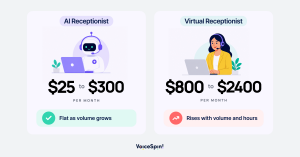
Cost is where the two options separate most sharply, though the headline number misleads on both sides.
Virtual receptionist and in-house costs
| Model | Typical range |
| Human virtual receptionist, monthly | $800 to $2,400 |
| Human per-minute billing | $1.20 to $3.50 per minute |
| Human per-call billing | $9 to $11 per call |
| 24/7 live coverage plans | $800 to $1,500 and up |
| Full-time in-house receptionist, loaded cost | $3,300 to $4,600 per month |
Figures are indicative market ranges compiled from published provider pricing and should be verified against current rates before you rely on them.
Coverage is the expense most often overlooked. A single assistant only works standard business hours, which leaves about three quarters of the week wide open. And don’t forget about the 35 to 45 percent of calls that start ringing outside of those hours – these calls are just begging for a decent answer. In reality, you need at least three to four people on the job to cover all the hours of the day, which makes all those other costs multiply before your very eyes.
AI receptionist costs
AI receptionist providers tend to charge in one of three ways: you pay a flat monthly fee, or they bill you on a per-minute basis, or they give you a base fee and then add a bunch of extra charges for usage too. Sometimes they even bill you for setup and integration costs as a separate item.
Across the board, AI-only receptionist services generally cost between $25 to $300 a month for small deployments. And if you were to compare the cost of an AI service to a live answering service that handles the same volume of calls, the savings are pretty staggering – we’re talking 85 to 95 percent less.
The structural difference matters more than any specific figure. Human cost scales linearly with volume and with coverage, because doubling either means employing more people. AI receptionist cost scales with usage but not with coverage, because round-the-clock availability costs the same as business hours, and handling fifty simultaneous calls costs the same per call as handling one.
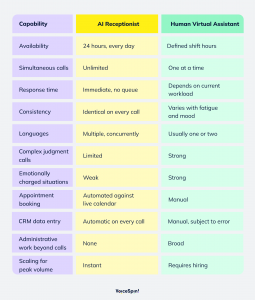
Feature Comparison
Where a Human Virtual Assistant Still Wins
There are situations where hiring a person is the better decision, and pretending otherwise leads to failed deployments.
Calls that are high in value and low in volume. If your business receives fifteen calls a day and each one is worth thousands of dollars, the economics of automation barely register. A person who builds rapport is worth more than any efficiency gain.
Emotionally sensitive contexts. Healthcare intake, legal matters, complaints, bereavement, and financial hardship all fall into this category. Callers in these situations need to feel heard, and current AI is not good at this. It can simulate acknowledgment, but callers detect the difference and resent it.
Where an AI Receptionist Wins
Handling High Call Volumes with Predictable Patterns. If most of your calls can be neatly slotted into a few different categories, an automated system can handle the bulk of it with ease, freeing up your human reps to deal with anything that’s a bit more unusual.
Catching Calls Beyond Business Hours. Let’s face it, a fair chunk of your calls are going to come in when the office is shut or during those peak periods when your phone just gets slammed – like lunchtime or late at night. With an AI receptionist on the case, you can catch those calls and handle them properly, rather than letting them fall through the cracks.
For Businesses That Are All About the Bookings. Places like clinics, salons, service companies and professional practices get an enormous number of calls that are just about one thing: booking an appointment, rescheduling, confirming something etc. These are all pretty routine tasks that an AI can handle from start to finish with no fuss.
Recommended reading: 7 Ways to Automate Your Customer Service and How AI Can Help
What AI Receptionists Still Handle Badly
Genuine emotional distress. An upset caller wants to be understood rather than processed. AI recognizes sentiment and adjusts tone, but recognition is not understanding, and callers sense the gap. Route these calls to a person quickly.
Requests outside configured logic. Unusual requests either get misrouted or produce a confident but wrong answer, which is worse than an admission of uncertainty.
Heavy accents, background noise, and poor line quality. Speech recognition still degrades under these conditions, and a caller forced to repeat themselves three times has had a bad experience regardless of what follows.
Callers who refuse to speak to a machine. A meaningful share of any customer base will not engage with automation. If the route to a person is buried, those calls are lost.
The practical answer to most of these is not choosing one option over the other. It is designing the handoff properly, which is what confidence scoring and escalation thresholds exist to manage. A system that recognizes when it is out of its depth and transfers cleanly, with the caller’s context attached, avoids most of the failure modes above.
Calculating the ROI
The useful calculation is not a comparison of monthly prices, because the two options do not deliver the same thing.
Step one: measure what you are losing now. Pull your missed call volume for a typical month, including calls outside business hours. Multiply by your average customer value and your historical close rate on inbound inquiries. Using the industry formula, a service business taking 50 calls a day with a 22 percent miss rate, a 25 percent conversion rate, and a $540 average customer value is losing in the region of $126,000 a year. Run the same arithmetic with your own figures, because this number is the actual size of the problem.
Step two: compare total cost of coverage rather than headline price. For the human option, include salary or service fees, recruitment, onboarding, management time, software, and absence cover, then multiply by the number of people required to reach your target coverage hours. For the AI option, include subscription, usage, and setup.
Step three: account for what each option cannot do. If a virtual assistant can also handle email and admin tasks, then that value needs to be in the calculation.
Businesses deploying AI reception typically see the clearest returns in recovered missed calls and eliminated hold time rather than in headcount reduction, which is worth establishing internally before deployment so that expectations match what the technology actually delivers.
The Hybrid Model
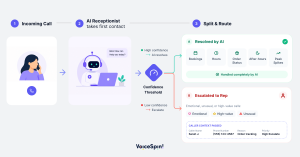
In practice, most businesses that get this right do not choose one option. They split the work between them.
The AI receptionist takes first contact on every call. It resolves the routine transactions completely, absorbs all after-hours volume, handles peak spikes, and writes caller information into the CRM automatically. Anything emotional, unusual, or high in value goes to a person, arriving with the caller’s details and the reason for the call already attached.
How to Decide
Work through these questions:
- How many calls do you receive each month, and how many currently go unanswered?
- What share of those calls follow predictable patterns?
- Do you need coverage outside business hours, and what share of your calls arrive then?
- What is a single missed call actually worth to you?
If your answers point toward high volume, repeatable requests, and coverage gaps, an AI receptionist will likely deliver the better return. If they point toward low volume, high individual value, and emotionally complex conversations, hire a person. If they point in both directions, which is the most common outcome, start with the hybrid model.
How VoiceSpin Can Help
VoiceSpin’s AI Voice Bot and AI Call Answering Service answer inbound calls conversationally, resolve routine requests without human involvement, book appointments against a live calendar, and escalate to your team with full context when a person is needed.
Because the system integrates with eleven CRM platforms including Salesforce, HubSpot, Zoho, and Microsoft Dynamics 365, caller details and call outcomes are written into your existing systems automatically rather than being entered manually after the fact. Every call is also available for review through our AI Speech Analyzer, which means the quality of automated handling is measurable rather than assumed.
Book a demo to see how it would handle your actual call patterns.
Frequently Asked Questions
How much does an AI receptionist cost compared to a virtual assistant?
You’ll see AI-only receptionist services ranging from $25 to $300 per month for smaller deployments – although higher volume implementations will cost more of course. On the other hand, a human virtual assistant can set you back between $12,000 and $94,000 annually, depending on location and experience, not to mention recruitment, onboarding, management costs, and factoring in someone to cover when they’re out. Human virtual receptionist services, meanwhile, tend to run $800 to $2,400 per month. Published comparisons estimate that you can cut your costs with AI by as much as 85 to 95 percent when compared to equivalent live answering coverage.
Can an AI receptionist replace a human receptionist entirely?
For some businesses, yes, an AI receptionist can definitely replace a human. Especially if they’re dealing in high volumes of routine, transactional calls. Yet for a lot of other places, it makes more sense to use AI as a first line of defense that deals with routine requests and then bounces anything that requires a bit of human judgment up to a person. Businesses that are dealing with emotionally sensitive or highly variable calls are probably best off just sticking with a human.
What is the difference between an AI receptionist and a virtual receptionist?
A virtual receptionist is just a person – usually one who works for an answering service and handles calls for multiple businesses. An AI receptionist is just software that performs the same job but does it conversationally without anyone on the other end of the line. One key difference is availability, since an AI can work all hours of the day with no extra cost. Another key difference is capacity – AI can handle multiple calls at the same time, whereas a person can only handle one.
How long does it take to set up an AI receptionist?
Deployment typically takes days to weeks, depending on how complex your call flows are and what systems it needs to connect to. That’s a lot quicker than recruiting, onboarding and fully training a human assistant, which can take weeks to months.
What happens when the AI receptionist cannot handle a call?
A properly set-up system recognizes when its confidence drops below a certain level and then transfers the call to a person. It passes along the caller’s details, as well as what was discussed so far. One of the most important decisions you’ll make in setting up an AI is getting that confidence threshold just right.
Is an AI receptionist worth it for a small business?
It depends on how much unanswered calls are costing you right now. It’s worth noting that around 62% of calls to small businesses go unanswered – and that 85% of those callers never even try again. Plus, a single missed call can cost you anywhere between $125 and $350. Recovered revenue like that often easily exceeds the subscription cost in the first month. Businesses that will see the least benefit, though, are probably those with very low call volume or calls that are highly complex and non-repeatable.

 +18889082995
 +442036084160
 +97237237006
 Call on WhatsApp

